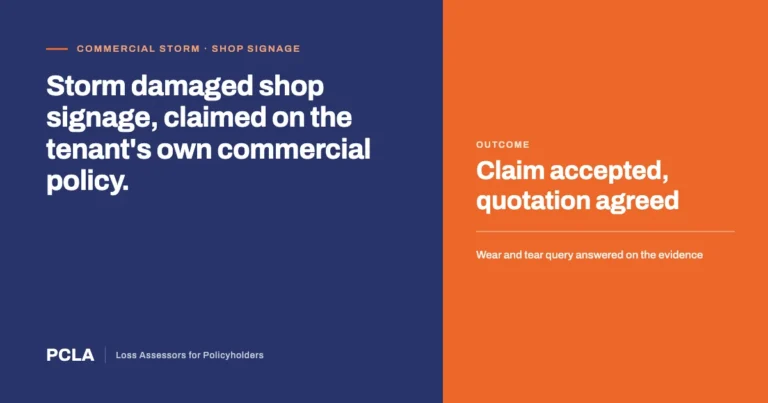
A shop owner in the Newry area contacted PCLA after storm damage affected the external signage at their commercial premises.
Storm Chandra affected Northern Ireland in January 2026. During the storm, signage was ripped from its fixings, leaving the shop frontage damaged and requiring urgent attention to make the area safe.
PCLA reviewed the commercial policy, confirmed that storm and signs were referenced in the cover, obtained specialist repair evidence and presented the claim to the insurer’s appointed loss adjuster.
After questions about policy cover and possible wear and tear were addressed, the claim was accepted and the contractor’s quotation was agreed, which allowed the client to arrange the repairs promptly.
Case Summary
| Detail | Information |
|---|---|
| Location | Newry area, Northern Ireland |
| Property type | Commercial premises |
| Claim type | Storm damage |
| Cause | Storm Chandra, January 2026, damage to external shop signage |
| Areas affected | External signage and shop frontage |
| Policy cover | Storm and signs referenced in the policy schedule |
| Client interest | Tenant-installed signage and fit-out |
| Evidence obtained | Specialist contractor quotation |
| Insurer contact | Loss adjuster |
| Main issue | Potential wear and tear argument |
| Outcome | Claim accepted and quotation agreed |
| Business impact | Repairs arranged to reduce disruption |
This Case May Be Relevant If
You may want to have your storm damage claim reviewed if:
- your shop signage, frontage or external fittings have been damaged during a storm;
- you lease the premises but paid for or installed the signage yourself;
- your insurer or loss adjuster has raised questions about wear and tear;
- you are unsure whether the damage falls under your policy or the landlord’s policy;
- the damaged signage is affecting the appearance, safety or trading position of the business;
- you do not have time to manage the insurer, contractor and loss adjuster yourself;
- urgent repairs are needed to prevent further damage or disruption.
An independent review of the policy and damage can help establish whether there is a valid claim and what evidence is needed to present it properly.
The Problem: Storm Damage to Shop Signage
The claim arose after Storm Chandra caused damage to the external signage of a shop in the Newry area in January 2026.
The storm ripped the signage from its fixings, leaving the external frontage damaged and requiring attention to make the area safe and return it to its pre-loss appearance.
For a customer-facing business, damaged signage is not simply a cosmetic issue. It can create safety concerns, affect how the premises appear and potentially interfere with normal trading.
The shop owner did not own the building. They had, however, fitted out the premises and were responsible for signage forming part of the shop frontage.
After speaking with a friend, the shop owner contacted PCLA to ask whether we could assist with the claim.
Policy Review and Insurable Interest
Before progressing the claim, PCLA asked to review the client’s commercial policy documentation.
Because the client occupied rather than owned the premises, PCLA needed to confirm both relevant policy cover and the client’s financial interest in the damaged signage.
The policy schedule confirmed that storm was an insured contingency and specifically referred to cover for signs at the commercial premises.
Although the client did not own the building, their responsibility for the fit-out and signage provided a basis for presenting the loss under their own commercial policy, subject to its terms.
Obtaining the Repair Evidence
Once the policy position had been reviewed, the next step was to obtain evidence of the reasonable reinstatement cost.
A specialist signage contractor inspected the damage and quoted for the necessary repair and replacement works, giving the insurer a clear breakdown of the reinstatement.
The proposed works included like-for-like replacement signage, associated lighting and bracket works, together with the access equipment needed to complete the repairs safely.
Reporting the Claim to the Insurer
PCLA reported the matter to the insurer and provided an early indication of the likely cost of the claim.
This allowed the insurer to set an appropriate reserve while the specialist contractor completed the detailed quotation.
Given the estimated value and nature of the loss, the insurer confirmed that a loss adjuster would need to inspect the damage.
PCLA arranged to meet the loss adjuster at the premises. By the time of the meeting, the contractor’s quotation was available and could be presented as evidence of the reinstatement cost.
The Loss Adjuster’s Queries
During the inspection, the loss adjuster raised several questions about policy cover and the cause of the damage.
One of the main issues was whether the loss was fully attributable to the storm or whether wear and tear may have contributed to the signage failing.
This was an important point because damage caused by gradual deterioration, poor maintenance or wear and tear may be excluded under a commercial property policy. The same argument comes up regularly on storm damage claims of every kind.
The Outcome: Claim Accepted and Repairs Arranged
PCLA addressed the loss adjuster’s questions and explained why wear and tear was not the relevant cause of the damage in this case.
The available evidence supported the position that the signage had been damaged as a direct result of the storm, and the loss adjuster accepted the claim.
The specialist contractor’s quotation was agreed, which allowed the client to arrange the necessary repairs and return the shop frontage to its pre-loss condition.
Resolving the policy and causation issues early also reduced the risk of the damaged frontage causing further disruption or developing into a business interruption concern.
What This Case Shows
This case demonstrates the importance of reviewing the policy position at the outset of a commercial property claim.
The client did not own the building, but that did not automatically prevent a claim. Their responsibility for the fit-out and signage, combined with the relevant policy cover, provided a route for the loss to be considered under their own commercial policy.
The successful outcome was supported by:
- an early review of the policy documentation;
- confirmation that storm was an insured contingency;
- confirmation that signs were specifically referenced in the policy schedule;
- a specialist contractor’s quotation for the reinstatement works;
- attendance at the loss adjuster’s inspection; and
- evidence-led responses to the questions about cover and causation.
The case also shows why causation evidence matters when an insurer raises wear and tear: the key issue is what caused the insured damage on the facts.
What Business Owners Can Learn
There are several practical lessons from this claim:
- Tenants may have an insurable interest in items they have paid for or installed.
- External signage may be covered by the tenant’s policy, not only the landlord’s.
- Check the policy wording and schedule before progressing a claim.
- Use a specialist quotation to evidence the reinstatement cost.
- Address wear and tear arguments with evidence of the actual cause.
- Act early to limit delay, further damage and business disruption.
Every claim depends on its individual facts, supporting evidence and policy terms. Where storm damage affects commercial signage, both the cause of damage and the correct policy route should be established as early as possible.
Has Your Business Suffered Storm Damage?
If your shop, office or other commercial premises has suffered storm damage, it may be worth having the policy and damage reviewed before accepting the insurer’s position.
PCLA acts for policyholders, not insurers. We review cover, inspect damage, obtain evidence and deal with the insurer or loss adjuster on the client’s behalf.
We help business owners across Newry, County Down, Northern Ireland and Scotland present commercial property damage claims clearly and address questions about cover, causation and reinstatement cost.
Contact PCLA for an initial discussion about your commercial property damage claim.
PCLA explains its fee and terms clearly before appointment.
Frequently Asked Questions
Can a tenant claim for damage to shop signage?
Yes, potentially. A tenant who paid for, installed or is responsible for the signage may have a financial interest in it. The policy wording and schedule must still be reviewed to confirm whether the relevant cause and property are covered. In this claim the client occupied rather than owned the premises, and their responsibility for the fit-out and signage provided the basis for presenting the loss under their own commercial policy.
Is storm damage to signage covered under a commercial property policy?
It can be, depending on the policy terms and the cause of the damage. In this case storm was an insured contingency and the policy schedule also referred specifically to cover for signs at the premises. That second point mattered, because a policy that covers storm damage to the building does not automatically extend to external signage.
What evidence answers a wear and tear argument about storm damaged signage?
The loss adjuster on this claim asked whether the signage had failed because of the storm or because of gradual deterioration. That question is answered with evidence about the cause, not with argument. What supported the position here was the timing of the damage against a named storm event, Storm Chandra in January 2026, the way the signage had been pulled from its fixings, and the specialist contractor’s assessment of the damage. The loss adjuster accepted the claim on that basis.
Why does a specialist contractor’s quotation matter on a signage claim?
A specialist quotation establishes the reasonable cost of reinstatement and identifies the work needed to return the signage to its pre-loss condition. On this claim it covered like-for-like replacement signage, the associated lighting and bracket works, and the access equipment needed to carry out the repairs safely. It also gave the insurer and the loss adjuster a clear basis on which to assess and agree the cost.
Who attends the loss adjuster’s inspection?
The loss adjuster acts for the insurer. On this claim PCLA arranged to meet the loss adjuster at the premises and attended the inspection with the contractor’s quotation already available, so the reinstatement cost could be presented as evidence at the meeting rather than exchanged afterwards. PCLA then addressed the queries raised about cover and causation.