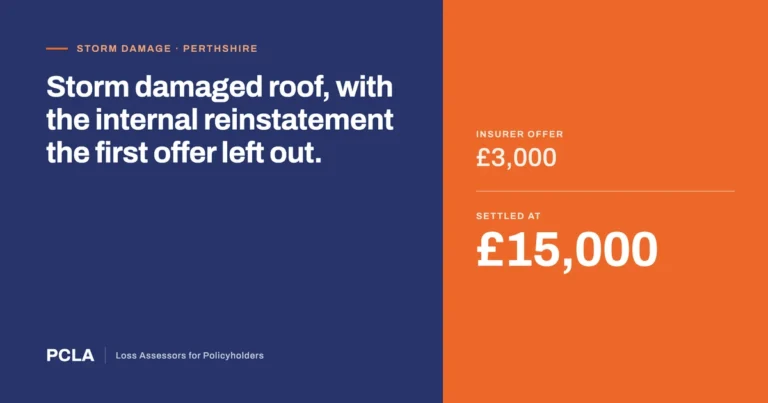
A homeowner in the Perthshire area contacted PCLA Scotland after their insurer offered £3,000 for storm damage to the roof of their home.
The property had suffered damage following a period of severe weather, with high winds and heavy rain affecting the roof covering. Rainwater then entered the property, causing internal damage to ceilings, wall finishes and decoration.
The insurer accepted that the claim fell under the storm damage section of the homeowner’s buildings insurance policy. However, the initial offer did not properly reflect the extent of the roof damage, the access required to complete the works, or the internal reinstatement needed following water ingress.
Following PCLA’s involvement, the insurer’s offer was reviewed and challenged. The scope of works was reassessed, the wider damage was considered, and the claim was negotiated to a final settlement of £15,000.
That represented a £12,000 increase over the insurer’s original offer.
Case Summary
| Detail | Information |
|---|---|
| Location | Perthshire area, Scotland |
| Property type | Residential property |
| Claim type | Storm damage |
| Initial insurer offer | £3,000 |
| Final settlement achieved | £15,000 |
| Increase secured | £12,000 |
| Main issue | Roof damage, access costs and internal reinstatement after water ingress |
| Outcome | Settlement agreed following review, challenge and negotiation |
This Case May Be Relevant If
You may want to have your storm damage insurance claim reviewed if:
- your insurer has accepted the claim but offered much less than the likely repair cost;
- roof damage has allowed rainwater to enter the property;
- the offer does not appear to include internal repairs, plastering or decoration;
- scaffolding or safe access costs have not been allowed for;
- the insurer has suggested that the issue may relate to wear and tear;
- the claim has been assessed as a small roof repair, but the damage appears wider;
- you have not accepted the insurer’s offer as a final settlement.
A review does not commit you to challenging the insurer. It helps you understand whether the offer reflects the likely cost of reinstatement before you make a decision. If you need help with a storm damage, contact our Loss Assessor team in Edinburgh.
The Problem: Storm Damage to the Roof
The claim arose after severe weather caused damage to the roof of the property.
Shortly after the storm, the homeowner noticed water entering the property. Further inspection identified damage to the roof covering, with rainwater penetration affecting internal ceilings and decorative finishes.
The homeowner made a claim under their buildings insurance policy for storm damage.
Storm damage roof claims can become disputed because insurers may consider whether the damage was caused by a storm event, or whether the issue relates to wear and tear, lack of maintenance or a pre-existing defect.
That distinction matters.
Most home insurance policies cover sudden and unexpected damage caused by storm. They usually exclude damage caused by gradual deterioration, poor maintenance or wear and tear. In practical terms, this means the insurer will often look closely at weather conditions, the age and condition of the roof, and whether the damage is consistent with storm impact.
In this case, storm damage cover applied. The issue was whether the insurer’s offer properly reflected the roof repairs, access requirements and internal reinstatement needed after water entered the home.
The Insurer’s Initial Offer
The insurer initially offered £3,000 in settlement of the claim.
Their assessment allowed for limited roof repairs and a small allowance for internal making good. However, the offer did not properly account for the full extent of the works required.
The insurer’s offer did not adequately reflect:
- the extent of storm-related roof damage;
- safe access requirements for roof repairs;
- associated making good works;
- internal water damage caused by rainwater entering the property;
- ceiling repairs;
- plastering and decoration;
- the practical cost of completing the works properly.
The homeowner was concerned that accepting the offer would leave them unable to complete the necessary repairs.
PCLA was appointed to review the insurer’s position and assist with the claim.
What PCLA Did
PCLA helped by:
- Reviewing the insurer’s £3,000 offer.
- Inspecting the storm-related roof damage and internal water damage.
- Reviewing whether the proposed scope allowed for safe access.
- Identifying omitted internal reinstatement works.
- Assessing the roof repair scope alongside the internal water damage.
- Preparing evidence to support the wider claim.
- Negotiating the settlement with the insurer.
This helped move the claim away from a narrow roof repair allowance and towards the full reinstatement work required following the storm damage.
Evidence Used in This Claim
The claim review was supported by evidence including:
- photographs of the roof damage;
- photographs of internal water damage;
- review of the insurer’s proposed scope;
- assessment of safe access requirements;
- evidence that internal damage followed rainwater entering through the damaged roof;
- consideration of the works required to return the property to its pre-loss condition.
This evidence was important because the dispute was not simply about the cost of a roof repair.
The issue was whether the insurer’s settlement allowed for the reasonable reinstatement required following the insured storm damage.
PCLA’s Review
Following instruction, PCLA reviewed the insurer’s offer, the damage present at the property and the proposed scope of works.
Our review found that the claim had been assessed too narrowly.
The damage was not limited to a minor roof repair. There was also internal damage caused by rainwater entering through the storm-damaged roof.
Where storm damage to a roof results in water ingress, the resulting internal damage may form part of the same insured event. This can include plasterboard, ceilings, wall finishes, decoration and associated making good, depending on the policy terms and the damage present.
The claim therefore needed to be considered as a whole, rather than as a small isolated roof repair.
What a Storm Damage Claim May Need to Consider
Storm damage cover is intended to respond where a storm causes sudden damage to the insured property.
Where a roof is damaged during a storm, the claim may include more than the cost of replacing a small number of tiles or slates.
Depending on the policy and the damage present, a properly assessed storm damage claim may need to consider:
- roof repairs directly caused by the storm;
- reasonable access costs, including scaffolding where required;
- temporary works to prevent further water ingress;
- internal repairs caused by rainwater entering through the damaged roof;
- plastering and redecoration;
- joinery or other making good works;
- professional or contractor costs where reasonably incurred;
- associated reinstatement required to return the property to its pre-loss condition.
This is where many low offers arise.
An insurer may accept that storm damage has occurred, but only allow for a limited repair. That can leave the policyholder without enough money to complete the works properly.
In this claim, the original offer did not properly reflect the roof damage, the access required, or the internal reinstatement needed after rainwater entered the property.
The Coverage Issue
The main issue was not simply the cost of the roof repair.
It was whether the insurer had properly assessed all damage arising from the insured storm event.
Where a policy covers storm damage, the insurer should consider the direct damage caused by the storm and the resulting damage caused by rainwater entering the property through the storm-damaged area.
The insurer may still be entitled to exclude unrelated wear and tear, poor maintenance or pre-existing deterioration. However, that does not mean a valid storm damage claim should be restricted to the cheapest possible patch repair.
If storm conditions caused new damage, and that damage allowed water to enter the home, the claim should be assessed on the basis of the reasonable reinstatement required, subject to the policy terms, limits and exclusions.
That was the key point in this case.
Why the Original Offer Was Too Low
The original settlement offer did not properly reflect the cost of returning the property to its pre-loss condition.
It failed to properly allow for the practical requirements of the repair, including the works needed to the roof and the internal damage caused by water ingress.
In particular, the offer did not adequately account for:
- the full storm-related roof repair scope;
- access required to safely carry out the works;
- making good around the affected roof area;
- internal ceiling repairs;
- plastering and redecoration;
- associated water damage;
- the realistic cost of using competent contractors;
- the need to complete the works properly rather than carry out a limited temporary repair.
The issue was not betterment. It was whether the settlement reflected the reasonable reinstatement required following the insured damage.
Settlement Achieved
Following PCLA’s involvement, the insurer increased its settlement from £3,000 to £15,000.
This represented a £12,000 increase over the insurer’s original offer.
The increased settlement allowed the homeowner to proceed with a more appropriate scope of repairs, including the storm-related roof works and associated internal reinstatement.
Result
| Detail | Outcome |
|---|---|
| Original insurer offer | £3,000 |
| Final settlement achieved | £15,000 |
| Increase secured | £12,000 |
| Claim type | Storm damage |
| Property type | Residential property |
| Location | Perthshire area, Scotland |
| Outcome | Settlement agreed following review of storm damage cover, roof repair scope, access requirements and internal reinstatement |
What Homeowners Can Learn from This Claim
This claim highlights several important points for homeowners dealing with storm damage.
First, do not assume that an insurer’s first offer reflects the true cost of repair.
Second, storm damage claims should not be assessed too narrowly. If roof damage allows water to enter the property, the resulting internal damage may also form part of the claim.
Third, insurers may raise issues such as wear and tear, lack of maintenance or pre-existing defects. Those issues need to be considered carefully, but they should not be used to reduce or avoid payment for genuine storm damage.
Fourth, access costs can be significant in roof damage claims. If scaffolding or other access arrangements are reasonably required to carry out insured roof repairs safely, they should be considered as part of the claim.
Finally, a policyholder is generally entitled to be put back into the position they were in before the insured damage occurred, subject to the policy terms, limits and exclusions.
Have You Received a Low Offer for Storm Damage?
If your insurer has accepted storm damage but the offer does not cover the roof repairs, safe access and internal water damage, it may be worth having the scope reviewed before accepting a final settlement.
PCLA acts for policyholders, not insurers. We inspect the damage, review the insurer’s offer, prepare evidence, produce a costed scope of works and negotiate with the insurer or their appointed loss adjuster on your behalf.
We help homeowners throughout Scotland with storm damage, roof damage, water ingress, fire, escape of water and other property damage claims.
If you need help with a storm damage claim in Scotland, speak to our loss assessor team or read more about storm damage insurance claims.
You can also read our guide on what happens when you appoint PCLA as your loss assessor.
Speak to PCLA about your storm damage claim.
A short call costs nothing and does not commit you to anything.
FAQs
Can I claim for storm damage to my roof?
Yes, if your policy includes storm damage cover and the damage was caused by an insured storm event.
The insurer will usually consider weather conditions at the time, the condition of the roof and whether the damage is consistent with storm impact.
Can internal water damage be included in a storm damage claim?
Yes. Where storm damage to the roof allows rainwater to enter the property, the resulting internal damage may form part of the same claim.
This can include ceilings, walls, plasterwork and decoration, depending on the policy terms and the damage present.
What if my insurer says the roof damage is wear and tear?
The age or condition of a roof may be relevant, but it does not automatically mean there is no cover.
Insurers may rely on wear and tear exclusions where they believe the damage was caused by gradual deterioration rather than storm. The key issue is whether storm conditions caused sudden new damage that is covered by the policy.
What evidence helps support a storm damage roof claim?
Useful evidence may include photographs of roof damage, photographs of internal water damage, weather records, contractor reports, repair estimates and a clear scope of works.
The stronger the evidence, the easier it is to show why the claim should not be treated as a limited repair.
Can I challenge a low offer for storm damage?
Yes. If the insurer’s offer does not reflect the reasonable cost of repair, it can be challenged.
A stronger challenge is usually supported by photographs, contractor estimates, weather evidence and a detailed scope of works.
Should scaffolding be included in a storm damage claim?
If scaffolding or other access equipment is reasonably required to carry out insured roof repairs safely, it should usually be considered as part of the claim.
This will depend on the nature of the works, the property and the policy terms.
Can PCLA help if the insurer has already made an offer?
Yes. PCLA can assist after an insurer has made an offer, provided the claim has not been finally concluded.
We can review the offer, inspect the property, prepare evidence and negotiate with the insurer on your behalf.
Does PCLA help with storm damage claims in Perthshire?
Yes. PCLA helps homeowners in Perthshire and across Scotland with storm damage, roof damage, water ingress and other property damage insurance claims.
Our role is to act for the policyholder, prepare the claim properly and negotiate with the insurer or their appointed representatives.