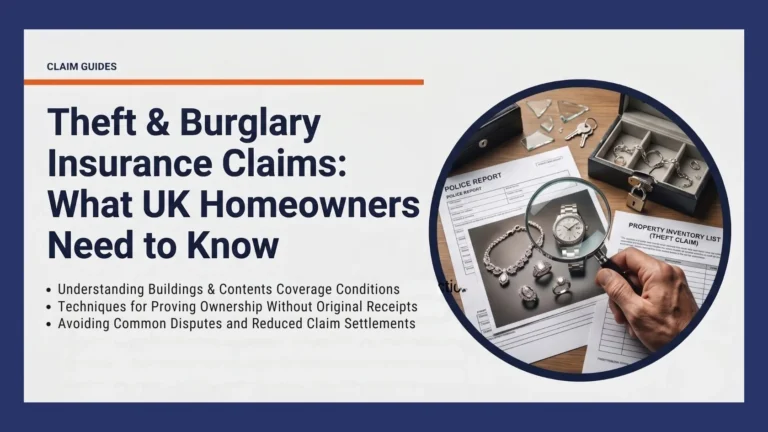
Coming home to a broken door or an emptied jewellery box is disorientating, and it’s normal to feel shaken well after the immediate danger has passed. On top of the shock, you’re now facing an insurance claim, working out what’s actually covered, what you can prove was taken, and what happens next. This guide explains what to do first, whether your insurance covers theft and burglary, how to prove ownership of stolen items when you don’t have receipts, and why these claims are sometimes disputed or reduced, written for homeowners across the UK, with particular detail for Northern Ireland and Scotland.
Safety comes first, always. Once you and your family are safe, this guide will help you understand the claim ahead of you.
What this guide helps you do
- Take the right steps in the first hours and days after a burglary, for your safety and for your claim
- Understand whether your buildings and contents policy covers theft and burglary, and what conditions commonly apply
- Prove ownership and value of stolen items, even without receipts
- Recognise the common reasons theft and burglary claims are challenged or reduced
- Know what happens during a claim, from reporting through to settlement
First steps after a burglary
- Call 999 if the burglary is in progress or you believe the intruder may still be nearby. If you’re discovering the aftermath of a burglary that’s already happened, report it to the police on 101 (or online, where your local force offers it) rather than 999.
- Don’t touch more than you need to. Fingerprints and other evidence can be lost quickly. Move carefully, avoid handling surfaces near the point of entry, and wait for police guidance before you start tidying up.
- Photograph and video the damage and the scene before anything is cleared away. Capture entry points, damaged doors, frames and locks, disturbed rooms, and the gaps left by anything taken, from multiple angles.
- Get a crime reference number. Insurers normally expect one as part of a theft or burglary claim, so make sure you have it before you contact them.
- Contact your insurer promptly, with the crime reference number to hand, and ask what they need from you next. Don’t authorise permanent repairs before your insurer has had the chance to record the damage, though making the property safe (a broken door, a smashed window) is generally fine and can usually be claimed for separately.
- Protect your accounts if cards, phones, laptops or documents were taken. Contact your bank to freeze accounts and cancel cards, change passwords on email and financial accounts, and set up transaction alerts.
- Start a list of what’s missing while it’s fresh in your mind. Note serial numbers where you know them, and consider registering valuable items on a free national property register such as Immobilise.
Once you’re safe and you’ve reported the burglary, PCLA can talk you through what comes next. Call 028 9581 5318 (NI) or 0141 461 2406 (Scotland). A short call costs nothing and doesn’t commit you to anything.
Key facts homeowners should know first
- Theft and burglary are standard insured perils on most UK home policies, but what's covered, and any conditions attached, depends on your specific policy wording.
- A missing receipt doesn't automatically end a claim. Insurers commonly accept photographs, bank or card statements, warranty documents and other evidence as proof of ownership.
- Damage isn't limited to what was stolen. Forced entry commonly damages doors, frames, locks and internal fixtures, and this is usually claimed alongside the stolen contents.
- Security and unoccupied-property conditions can affect a claim, though whether they apply depends on your wording, not just on whether you had them fitted.
Start here if…
- You want to know whether you're covered
- You don't have receipts for what was stolen
- Your claim has been challenged, reduced or refused
- You want to know what happens next
- You want help managing the claim itself
Does home and contents insurance cover theft and burglary?
Theft and burglary are standard insured perils under most UK home buildings and contents policies, though what’s covered, and any conditions attached, depends on your specific policy wording.
Contents insurance typically covers your belongings, furniture, electronics, jewellery and other possessions, up to your overall contents limit and any single-item limits set out in your schedule. Buildings insurance typically covers damage to the structure caused during a break-in, doors, frames, locks, windows and internal fixtures, separately from the value of what was stolen.
Forced entry is often, though not always, a condition. Many policies expect evidence that entry was forced, such as a damaged door or window. Theft without visible force, for example where a key was left in an obvious place, can be treated differently depending on the policy.
Outbuildings, garages and sheds are often covered, but usually with lower limits than the main house. Tools, garden equipment and bicycles kept outside the main property are common areas where a policy’s limits catch homeowners by surprise.
Unoccupied-property conditions can matter if the burglary happened while you were away. Some policies require the property to be checked periodically, or restrict cover if it’s been empty beyond a set number of days.
Coverage statements here are necessarily general. Always check your own policy wording, and if you’re unsure, an independent review can clarify your position.
High-value items and policy limits
Jewellery, watches, antiques, artwork and other valuables are frequently subject to a single-item limit, a cap on what the policy pays for any one item, even where the overall contents sum insured is much higher. If an item’s value exceeds that limit, it may need to be specified separately on your policy for full cover to apply.
This often only comes to light after a burglary. It’s a frustrating discovery, but it’s a feature of how the policy was set up rather than something PCLA can change after the event. What PCLA can do is help you understand how the limits apply to your specific items, and make sure nothing is undervalued within whatever cover does apply.
Proving ownership and value without receipts
This is, for many homeowners, the single most stressful part of a theft claim: the insurer wants proof of what you owned and what it was worth, and the item is gone, along with any paperwork that might have proved it.
A missing receipt is common, not fatal. Insurers routinely deal with claims where receipts aren’t available, and a range of alternative evidence can support ownership and value, including:
- Photographs of the item, ideally showing it in your home, worn, or in use
- Bank, credit card or PayPal statements showing the original purchase
- Warranty documents, service records or repair invoices
- Insurance valuations or jeweller's certificates, particularly for higher-value jewellery and watches
- Serial numbers, recorded separately or via a registration platform such as Immobilise
- Gift confirmation, such as a card, email or message referring to the item
- Product manuals or original packaging, if kept
No single piece of evidence needs to carry the whole claim. Honesty matters throughout: describe what you had as accurately as you can, and don’t inflate values or claim for items you didn’t own.
For heirlooms and gifted items with no purchase record at all, a reasonable description, photographs if you have them, and an honest account of how long you’d had the item are usually the best you can do, and insurers do commonly accept this kind of evidence.
If you’re struggling to put an evidence pack together, this is exactly the kind of gap PCLA can help close before you submit anything to your insurer.
What counts as a valid theft or burglary claim
- Burglary generally involves forced or unauthorised entry into the home, with theft and often damage as part of the same event.
- Theft from the home without forced entry, for example by someone already inside the property, may be covered but can be assessed differently.
- Theft from a garden, driveway or unlocked vehicle is often covered under a different part of the policy, or subject to its own limits.
- Theft accompanied by malicious damage is usually still covered under the same claim, subject to policy wording.
Common reasons theft and burglary claims are denied
- No evidence of forced entry, where the policy requires it.
- Disputed ownership or valuation.
- Underinsurance: if your contents sum insured doesn’t reflect what you actually own, insurers can apply “average,” reducing the settlement proportionately.
- Security or unoccupied-property conditions weren’t met.
- Late reporting.
- Items excluded or capped by the policy e.g. cash, specific valuables, or items kept in outbuildings.
A claim being challenged on one of these points doesn’t mean it’s over. You can ask your insurer for their reasoning in writing, provide further evidence, and seek an independent review before accepting a reduced offer or a refusal. If a dispute can’t be resolved directly, the Financial Ombudsman Service can review home insurance complaints. PCLA doesn’t provide legal advice, but can help review the evidence, policy wording and correspondence that sit behind a dispute.
What happens during a theft or burglary claim
- Reporting: police (crime reference number) then insurer.
- Initial documentation: photographs, initial list, crime reference number.
- Assessment: insurer may appoint a loss adjuster for larger/complex claims.
- Evidence and valuation: proof of ownership and value, scope of property damage.
- Negotiation: where there’s disagreement over valuations, evidence or conditions.
- Settlement: claim agreed, funds released.
Loss adjuster or loss assessor: who's acting for you?
Your insurer may appoint a loss adjuster to inspect the damage and assess your claim, particularly where the claim is sizeable or complex. The loss adjuster is appointed and paid by the insurer, and reports to them.
A loss assessor, such as PCLA, is appointed by you, the homeowner, and acts for you, reviewing the damage, gathering evidence, preparing your schedule of losses, and negotiating the settlement on your behalf. Both roles are legitimate; the difference is who has appointed them and whose interests they represent. Read our loss assessor versus loss adjuster versus broker guide. For how PCLA handle a theft or burglary claim from first notification to settlement, see our theft and burglary claims service.
Should I accept the insurer's settlement offer?
You don’t have to accept an offer immediately. You can ask for an explanation of how the figure was reached, query anything that looks low against the evidence you’ve provided, and raise any items you feel weren’t properly valued. A settlement isn’t final until you’ve agreed it.
Case Study · Edinburgh
An Edinburgh burglary claim, settled at £18,742.65
A family living in a four-bedroom detached home in Edinburgh returned from an evening out to discover their property had been burgled.
Despite having a monitored alarm system, CCTV and a video doorbell, the offenders forced entry through the rear of the property before carrying out a targeted search of the home.
Items stolen included gold and diamond jewellery, family heirlooms with significant sentimental value, cash, two laptops, two iPads, mobile phones, designer watches, and cameras and other electronic devices. The burglary also caused extensive damage to the property, including the rear external door, door frame and multi-point locking system, internal doors, built-in wardrobes and bedroom furniture, and damaged flooring and decorations.
PCLA managed the claim, preparing a detailed schedule of losses, gathering evidence to support ownership and value for the stolen items, documenting the damage to the property, and negotiating with the insurer.
The claim was settled for £18,742.65.
“The burglary left us completely shaken. It wasn’t just the things that were stolen, it was knowing someone had been through every room in our home. We didn’t know where to start with the insurance claim. PCLA dealt with everything, explained the process clearly and took a huge amount of stress away from us during a really difficult time.”
Sentimental items can never truly be replaced, but PCLA’s role was to make sure the full extent of the insured losses was properly documented and presented to the insurer.
Case details shared with the permission of the policyholder.
Frequently asked questions about theft and burglary claims
Does home insurance cover burglary and theft?
Yes — theft and burglary are standard insured perils on most UK home policies. What’s covered, and any conditions attached, depends on your specific policy wording.
Do I need to prove forced entry to claim after a burglary?
Many policies expect evidence of forced entry, such as a damaged door or window, but not all do. Theft without visible force can be treated differently depending on your wording.
What if I don't have receipts for what was stolen?
A missing receipt doesn’t end a claim. Insurers commonly accept photographs, bank or card statements, warranty documents, valuations and serial numbers as proof of ownership and value.
Are items in my garage, shed or garden covered if they're stolen?
Often yes, but usually with lower limits than the main house. Tools, garden equipment and bicycles kept outside are common areas where a policy’s limits catch homeowners by surprise.
What happens if my jewellery or valuables are worth more than my policy's single-item limit?
The policy may only pay up to that single-item limit unless the item was specified separately on your schedule. This often only comes to light after a burglary.
What's the difference between a loss adjuster and a loss assessor?
A loss adjuster is appointed and paid by the insurer and reports to them. A loss assessor, such as PCLA, is appointed by you and acts on your behalf throughout the claim.
Why might a theft or burglary claim be reduced or refused?
Common reasons include no evidence of forced entry, disputed valuations, underinsurance, unmet security or unoccupied-property conditions, late reporting, or items excluded or capped by the policy.
Will making a burglary claim affect my future home insurance?
A claim can affect future premiums, and insurers ask about previous claims when you renew or switch. It’s worth weighing this against the value of the loss you’re claiming for.
Can PCLA help if my theft or burglary claim has already started?
Yes. PCLA can step in at most stages to review the evidence, policy wording and correspondence, and negotiate with your insurer on your behalf.
Get help with your theft or burglary claim
If your home has been broken into and you’re unsure what your claim involves, an independent loss assessor can review your situation and explain your options. A free initial conversation doesn’t commit you to anything.
Call: 028 9581 5318 (NI) · 0141 461 2406 (Scotland)