
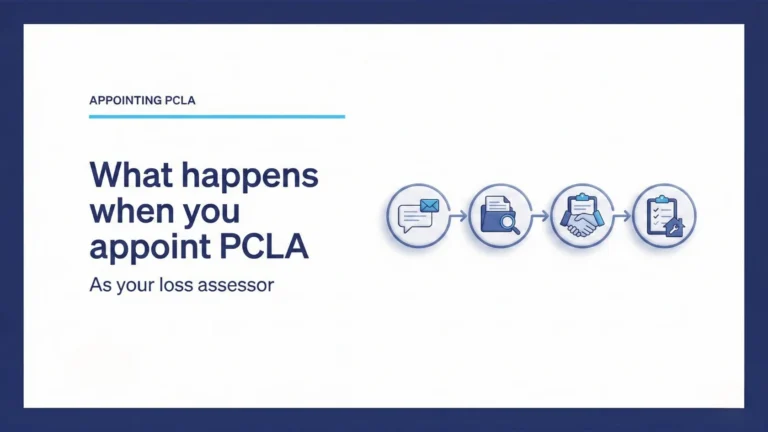
If you’re close to appointing a loss assessor, the biggest unknown is usually not “what do they do?” but “what will this actually be like day-to-day?”
This guide is designed to remove surprises. It sets out the typical stages of working with PCLA, what we do at each stage, what we need from you, and what you can expect to get back. It also covers communication, fees, and what you are (and are not) committing to.
Step 1: Initial Conversation and Claim Review
What happens
We start with a practical conversation about what happened, what has already been done, and what matters most to you right now (for example: making the home safe, stopping further damage, temporary repairs, or getting a clear scope for reinstatement).
What we do
- Listen to your situation and clarify the basics (cause, timeline, insurer involvement, current access/safety issues).
- Review what claim activity has already happened (if you have contacted your insurer, if a loss adjuster has attended, if you have any offers or requests for information).
- Explain the overall claim pathway in plain language: what usually comes next, what tends to slow claims down, and what decisions you may need to make.
- Flag immediate “do now” priorities where relevant (making safe, preventing further damage, documenting what’s changed).
What we need from you
- Your policy schedule/documents if you have them.
- Any insurer emails/letters and your claim reference (if a claim is already logged).
- A brief description of what happened and when.
- Any photos or videos you already have.
What you get
- A clear view of the next steps, without jargon.
- A realistic plan for how we would approach your claim.
- A clear explanation of what we would need to begin acting for you.
Step 2: Site Visit and Damage Assessment
What happens
If the claim warrants it, we arrange an early site visit. This is where “what you can see” is translated into “what can be evidenced and costed”.
What we do
- Assess the affected areas systematically (building fabric, fixtures/fittings, and where relevant, contents).
- Take photographs, notes, and measurements to document the scope.
- Identify immediate issues that can affect claim progression (access, safety, temporary works, damp/drying concerns, hidden damage risk).
- Where the claim is complex, we may recommend specialist input (for example: a quantity surveyor, engineer, or other expert) depending on what’s needed to evidence the position.
What we need from you
- Access to the affected areas (and any locked rooms/outbuildings if relevant).
- A short account of what has changed since the incident (clean-up, strip-out, emergency works).
- Details of any contractors who have attended (plumber, electrician, roofer, drying company, etc.).
What you get
- A documented record of the damage and likely scope.
- Early clarity on what should be treated as urgent versus what can wait.
- Fewer “back-and-forth” questions later, because the evidence baseline is set early.
Example (escape of water): the visible staining and swollen flooring is not always the full picture. A thorough assessment looks at what sits behind finishes and what needs to be evidenced to justify drying or strip-out decisions.
Example (fire): the initial focus is safety and the full reinstatement scope. Depending on the circumstances, smoke contamination, electrics, or structural elements may need careful substantiation before decisions are made.
Step 3: Building the Case – Evidence, Costs and Policy Review
This is where a claim becomes “properly claim-ready”: evidence is organised, policy wording is understood, and costs are structured into a credible schedule.
What happens
We gather and organise information so the claim is presented clearly and comprehensively.
What we do
- Evidence pack: compile photos/videos, measurements, inventories (where relevant), and supporting documents.
- Policy review: read the relevant wording carefully (cover, sums insured, excess, conditions, exclusions, endorsements, definitions) so the claim is built around what is actually covered.
- Scope and costing: build a clear schedule of works and valuations. For more complex claims, we may involve specialists so the scope and pricing are robust.
- Create an audit trail: keep key points, questions, and insurer responses tracked so progress does not rely on memory or informal updates.
What we need from you
- Policy documents and insurer correspondence.
- Receipts/invoices for emergency works and mitigation steps.
- Any pre-incident photos (if available), purchase records for higher-value items (where relevant), and a simple timeline of events.
- Your priorities and constraints (for example: work schedules, vulnerable occupants, temporary accommodation pressures).
What you get
- A structured claim submission that is easier for the insurer to process.
- Clear supporting evidence for the scope and cost.
- Reduced risk of missed items, vague wording, or under-scoped reinstatement.
Step 4: Negotiating With Your Insurer and Their Loss Adjuster
What happens
Once you appoint us, we act as your representative for the claim and become the main point of contact with the insurer and their appointed parties (including loss adjusters).
What we do
- Handle insurer questions, requests for information, and follow-up inspections in a controlled, evidence-led way.
- Present and defend the claim schedule with supporting documentation.
- Review insurer responses and offers line-by-line (not just headline figures).
- Keep key positions confirmed in writing wherever possible, so decisions are recorded clearly.
What we need from you
- Authority to act on your behalf (see “What you sign / what you don’t sign” below).
- Timely decisions when insurer responses require a choice (for example: agreeing access, authorising a specialist report, confirming reinstatement preferences).
What you get
- A professional, firm, evidence-led claim process without unnecessary confrontation.
- Less personal stress from “chasing” and repeated explanations.
- A clearer basis for discussions about scope, methodology, and cost.
A note on tone: negotiation in insurance claims is not about being combative. It is about being organised, well evidenced, and clear on what is covered and why.
When the claim feels slow: what’s normal, and what needs attention
Claims often involve routine “friction” (questions, re-visits, waiting on reviews). This helps you spot what’s ordinary versus what’s worth pausing on, without jumping to worst-case assumptions.
Often normal even in well-run claims
- Follow-up questions after the first submission (clarifying details or scope).
- A re-visit requested to confirm measurements, access, or the extent of damage.
- Delays while reports or quotes are reviewed (especially on multi-trade repairs).
- An initial offer that doesn’t reflect the full schedule (a first position rather than the final view).
- Requests for clearer photos, dates, or receipts to support specific items.
Worth pausing on (we’ll help you sense-check)
- Repeated requests for the same information with no clear reason.
- Long gaps with no meaningful update or next step stated.
- Offers presented without a breakdown or explanation of what’s included.
- Scope changes that remove items without addressing the evidence provided.
- Confusing messages from multiple insurer contacts (mixed instructions or shifting positions).
What we do next (calm, practical steps)
- Clarify what’s being asked and why, so you’re not guessing.
- Confirm key positions in writing and keep a clear audit trail.
- Request breakdowns where needed, so decisions are based on facts not frustration.
- Tell you when we need something from you — and when you can ignore the noise.
You don’t need to interpret every insurer message alone. We’ll translate what matters, what’s routine, and what needs a response.
Step 5: Agreeing Settlement and Managing Next Steps
What happens
When settlement is agreed, the focus shifts from “what’s covered?” to “how do we turn this into the right repairs and a workable plan?”
What we do
- Confirm what has been agreed (scope, figures, any conditions) and ensure it is clearly documented.
- Explain what the agreement means in practice: what is included, what is not, and what actions follow.
- Support next steps around reinstatement planning and practicalities, depending on how your claim is being handled and what support you need.
What we need from you
- Confirmation of your preferred route forward (for example: whether you already have trusted contractors, any access constraints, preferred sequencing, or time pressures).
- Ongoing documentation for anything that changes after agreement (for example: additional works uncovered during reinstatement).
What you get
- Clarity on the end point and how to implement it.
- Reduced risk of misunderstandings about what the insurer has agreed to pay for.
- A calmer handover from claim resolution into repair/reinstatement reality.
Communication: How Often You’ll Hear From Us and in What Format
Good claim handling is often about communication quality: the right update at the right time, in a format that works for you.
How we communicate
We generally default to your preference and can use multiple channels as needed, including:
- Phone calls;
- Text (SMS and WhatsApp);
- Email;
- Call-outs / on-site meetings where appropriate.
What you can expect
We keep communication lines open and aim to be approachable. Updates are driven by the claim’s “pressure points” — for example:
- after a site visit;
- after claim submission;
- after insurer questions or requests;
- after an offer or partial offer;
- before/after key meetings or re-inspections;
- when we need a decision or documents from you.
If there is no meaningful change, we can still confirm where things stand so you are not left wondering. If you have a strong preference (for example: “email for documents, WhatsApp for quick updates”), we can work to that.
Fees: Transparent, Upfront, and Explained
We believe you should understand fees before you commit to anything.
Our standard fee basis
PCLA charges 10% of the final settlement + VAT.
How this is discussed
- We will explain fees upfront, in simple terms, before you appoint us.
- We will talk it through with you directly and answer questions, including what the fee applies to and how it is calculated.
- You will also have the terms set out clearly in writing as part of the appointment process.
The goal is that you can make a decision with full clarity, rather than feeling pressured or uncertain.
What you’re agreeing to (and what you’re not) when you appoint PCLA
If you’re in an early–mid claim in Northern Ireland, it’s normal to want clarity on commitments before you decide.
What you sign / agree
- Authority to act (instruction/mandate): Allows us to speak to your insurer and manage the claim on your behalf.
- Fee terms in writing: We explain the fee basis upfront and confirm it clearly in writing.
- Sharing claim information: So we can review correspondence, evidence, and insurer requests properly.
- Working together on decisions: We guide you, but you remain the decision-maker on key choices.
What you don’t sign / what this isn’t
- No guaranteed outcome: No reputable claims professional can promise a result.
- No surprise extras: If specialist input is needed, we explain why and discuss it first.
- No conflict-first approach: We keep communication professional, clear, and evidence-led.
- No need to chase: You shouldn’t have to manage insurer admin alone once we’re acting.
If anything isn’t clear, ask us. We’d rather explain it properly than leave you guessing.
Plain-English definitions
Mandate / authority to act
Permission to communicate with your insurer and progress the claim for you.
Final settlement
The agreed settlement amount at the end of the claim.
10% + VAT
A percentage fee calculated from the final settlement (VAT added). We explain how this works upfront, in person, and you can ask any questions before you appoint us.
What You Sign and What You Don’t Sign
To reduce “hidden commitment” anxiety, here is what appointment typically involves.
What you sign
- Authority to act (instruction/mandate): this allows us to speak to the insurer, correspond on your behalf, and progress the claim in a structured way.
- Fee terms in writing: a clear statement of the fee basis (10% + VAT of the final settlement) and the key terms.
What you do not sign
- You are not signing up for “surprises”, unclear extras, or deliberately complex wording.
- You are not committing to a guarantee of outcome (no one reputable can promise that), but you are appointing a professional representative to manage and evidence your claim properly.
If you want to understand any clause before signing, that is encouraged. Ask, and we will explain it.
What We Need From You: A Simple Checklist
To make the process smoother, these items help early:
- Policy schedule/documents (if available)
- Insurer correspondence and claim reference (if already logged)
- Photos/videos (especially early images, before anything changed, where safe)
- Receipts/invoices for emergency works and mitigation
- A short timeline of events (what happened, when, who attended)
- Contractor details (plumber/electrician/roofer/drying company, etc.)
- Your priorities (habitability, speed, minimising disruption, reinstatement preferences)
If you do not have everything, do not worry. We will work with what you have and tell you what matters most next.
Real Examples of How This Looks in Practice
These are anonymised “what it looks like” examples focused on process rather than outcomes.
Example 1: Escape of Water in a family home
- Initial call: for an escape of water claim, we confirm what happened, what has already been done, and whether further damage risk remains.
- Early visit: document damage, identify areas where the visible issue may not reflect the full scope.
- Case build: organise evidence, review policy wording, and create a clear schedule of works and costs.
- Insurer engagement: manage questions, push for clarity on scope, and keep decisions confirmed in writing.
- Agreement and next steps: confirm settlement terms, explain what they mean practically, and support the transition into reinstatement.
Example 2: Fire damage with complex reinstatement considerations
- Safety-first assessment: identify immediate risks and what needs specialist input.
- Evidence and scope: document damage, consider contamination impacts, and build a reinstatement scope that is defensible.
- Structured negotiation: manage insurer/loss adjuster queries and ensure responses address the actual scope, not just the headline.
- Settlement clarity: confirm what’s agreed and ensure the homeowner understands the next steps.
How to Decide if PCLA Is Right for You
Appointing a loss assessor should feel like a sensible step, not a leap into the unknown.
PCLA may be a good fit if:
- The claim is complex (scope, causation, multiple trades, significant reinstatement).
- You are getting slow progress, unclear answers, or changing positions from the insurer side.
- You want a professional to handle evidence, documentation, and negotiation.
- You are worried about missing items or accepting a scope that is too narrow.
You may decide you do not need a loss assessor if:
- The damage is straightforward, fully agreed, and you are comfortable managing the paperwork and negotiation yourself.
- The insurer has already provided clear scope and timelines, and communication is strong.
- You have time, capacity, and confidence to manage the process end-to-end.
If you are unsure, an initial conversation can help you decide without pressure.
Next Steps
Book an initial conversation with PCLA
If you want to understand what your claim would look like with professional support, you can book an initial conversation and we will talk through your situation and the likely pathway.
Helpful related resources
- Book A Free Claim Review (what we check and why)
- Home insurance claim help in Northern Ireland
- Do I need a loss assessor?
- Learn More: Guides and Downloads