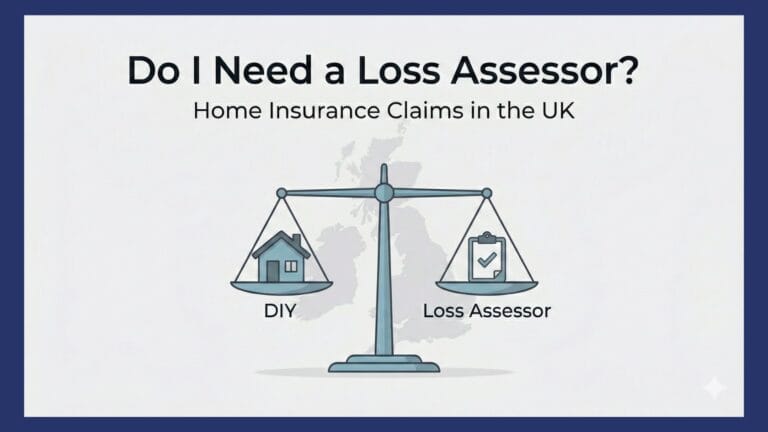
If you’ve already reported damage to your insurer (or you are about to) and you are now deciding whether to bring in a loss assessor, you’re in the right place.
This guide is for homeowners in an early to mid-stage home insurance claim who want a straight, proportionate answer. It will help you decide whether a loss assessor is likely to add meaningful value in your situation, or whether handling the claim yourself is the sensible option.
It’s not a sales pitch. In many smaller, straightforward claims, the honest answer is that you may not need help.
Is a loss assessor likely to be proportionate for your claim?
A quick orientation to help you sense-check where you sit before you work through the rest of the guide.
Often reasonable to DIY (if you’re comfortable managing it)
- Damage is contained (one area or one room).
- What needs repaired is obvious and easy to describe.
- You’re getting clear next steps and timely replies.
- You can manage quotes, emails, and follow-ups without it becoming a burden.
- You’re not worried about hidden damage or missed items.
Often worth independent help (even just to sanity-check scope)
- More than one room or part of the building is affected.
- Water damage may have spread beyond what you can see.
- You’re unsure what should be included in reinstatement.
- You’re repeating yourself to different people or the plan keeps changing.
- It’s already eating time and headspace you do not have.
- You’re worried the “obvious repairs” won’t fully put the home back.
The three questions to ask yourself first
Most of the decision comes down to three practical questions. Answer them honestly and the “right” option is usually obvious.
1) How complex is the damage and reinstatement?
Complexity is not just about how bad the damage looks on day one. It is about how many moving parts sit behind putting your home back to pre-loss condition.
Complexity is usually higher when:
- More than one room is affected;
- There is likely hidden or secondary damage (common with water);
- Repairs involve multiple trades and sequencing;
- You need drying, strip-out, or temporary works before reinstatement;
- Alternative accommodation, contents, or hygiene/safety issues are involved.
If you can describe the damage in one sentence and the repair scope feels self-evident, it is often a simpler claim. If you are already unsure what should be included, complexity is probably higher than it looks.
2) How confident are you managing the claim work?
Managing a claim well typically involves more than reporting it and waiting:
- Capturing evidence clearly;
- Checking what has been allowed for (and what has not);
- Querying gaps without creating noise;
- Keeping momentum when there are delays or unclear next steps.
Some homeowners are comfortable doing this. Others would rather delegate it. Either approach can be sensible. The key question is whether you have the time and appetite to stay on top of it for weeks or months if needed.
3) What is realistically at stake if the scope is wrong?
Think about “what’s at stake” as the difference between:
- A basic scope that gets the obvious repairs done, and;
- A complete scope that includes everything needed to properly reinstate.
In some claims, that gap is small. In others, it can be material. You do not need to guess the exact number today. You just need to recognise whether the gap could be meaningful.
If you are primarily worried about timelines, use: How Long Does a Home Insurance Claim Take. This guide stays focused on the decision of whether to appoint help.
A simple “worth it” check you can do in two minutes
This is not a calculator, but it is a simple way to think clearly.
Score each factor from 0 to 2.
Factor A: Claim size
- 0: Low value / limited repairs
- 1: Medium value / several items but contained
- 2: High value / significant reinstatement
Factor B: Complexity
- 0: Single area, obvious scope
- 1: Multi-item, some uncertainty
- 2: Multiple rooms, hidden damage likely, sequencing needed
Factor C: Your time and tolerance for admin
- 0: You can manage calls, emails, quotes, and follow-ups
- 1: You can do some, but it will be a strain
- 2: You do not have the capacity or you want to delegate fully
Factor D: Friction so far
- 0: Clear communication, sensible next steps, no confusion
- 1: Some delays or unclear scope
- 2: Repeated delays, mixed messages, or you are not confident you are being heard
How to interpret your total (0–8):
- 0–2: Often reasonable to DIY if you are comfortable doing so
- 3–5: Borderline. A short, no-pressure conversation can clarify whether help would actually change the outcome
- 6–8: Professional involvement is more likely to be proportionate, because either the claim is complex, the stakes are higher, or the friction is already real
If your main issue is “something feels off”, read this guide: Five Signs Your Home Insurance Claim Is in Trouble.
Claims where a loss assessor often makes a big difference
A loss assessor’s value is usually highest when the outcome depends on getting the scope right and presenting it clearly.
Multi-room or building-wide damage
When several areas are affected, omissions are easier to miss. A thorough, evidence-based scope reduces the risk of “quiet gaps” that only appear when reinstatement starts.
Escape of water with hidden or secondary damage
Water damage often extends beyond what you can see on the surface. The decision point is not only whether the claim is covered, but whether the full extent of damage and reinstatement requirements are being recognised.
For a broader orientation on this claim type, see: Escape of Water Insurance Claims.
Claims with early friction or uncertainty
If you are already dealing with unclear next steps, shifting responsibilities, or repeated delays, it can be hard to “DIY your way out” of that without a structured approach.
This is not about confrontation. It is about clarifying the facts, the scope, and the next actions so the claim can move forward on a more stable footing.
Friction check: what’s often normal, and what needs a clearer answer
A quick triage for early/mid home insurance claims in the UK. Not exhaustive.
| Usually normal at early–mid claim |
|
|---|---|
| Worth noting (ask one clear question and record the answer) |
|
| Needs attention (pause and get clarity before you assume it’ll sort itself) |
|
Usually normal at early–mid claim
- A few days between updates while inspection is arranged.
- Being asked for photos, receipts, or basic information.
- Initial scope feels “high level” before contractor quotes.
Worth noting (ask one clear question and record the answer)
- Next step is unclear (“we’ll be in touch”) with no timescale.
- Different people give different explanations for the same point.
- You’re asked for the same evidence more than once.
Needs attention (pause and get clarity before you assume it’ll sort itself)
- Scope is changing without a written explanation.
- Key parts of damage are described as “not included” without clarity on why.
- Progress stalls after inspection with no clear plan for reinstatement.
Situations where you need to reduce personal load
Even if a claim is manageable, delegating the admin and negotiation can be a rational choice if you cannot spare the time or headspace.
Claims where you may not need a loss assessor
There are plenty of situations where a loss assessor is unlikely to add enough value to justify the fee.
Small, contained, clearly covered claims
If the damage is limited, the scope is obvious, and the insurer process is moving sensibly, DIY handling is often reasonable.
Straightforward insurer scope that matches what you expected
If the assessment covers what you believe is required to reinstate properly and communications are clear, there may be little to add.
You are confident and willing to manage the detail
If you have the time, you are organised, and you are comfortable asking clear questions, handling the claim yourself can be a good option.
In practice, a credible loss assessor should be willing to tell you when you do not need one.
How to think about fees versus potential gain
The useful question is not “How much does a loss assessor cost?” It is:
“What problem would they solve that I cannot solve (or do not want to solve) myself?”
Fees tend to be easier to justify when one or more of the following are true:
- The claim is large enough that getting the scope right really matters;
- Complexity makes it easy for things to be missed;
- You are already experiencing friction or uncertainty;
- You want to reduce the time and stress of managing the process.
Fees are harder to justify when:
- The claim is small and straightforward;
- The insurer’s scope is complete and sensible;
- You have the time and confidence to manage the claim yourself.
If you want a step-by-step explanation of what typically happens after you report a claim, use: What To Expect From Your Insurer After You Report a Property Damage Claim.
Case studies that show when it is worth it (and when it is not)
These are simplified, non-confidential examples that reflect common patterns seen in UK claims.
Example 1: Multi-room water damage with hidden issues (often worth it)
A leak affects the kitchen ceiling and two upstairs rooms. The visible staining is obvious, but the real question is what sits behind the surface: flooring edges, joinery swelling, plaster integrity, and drying requirements.
Why it can be worth it: the scope is easy to under-state unless it is evidenced and itemised properly.
Example 2: Single-room escape of water with clear repairs (often DIY)
A small leak damages a section of ceiling in one room. The cause is fixed, the damage is contained, and a straightforward repair and redecorate is all that is needed.
Why it is often not worth it: the scope is simple and the upside from professional negotiation is typically limited.
Example 3: Claim progressing but communications are unclear (borderline)
Damage is not huge, but the homeowner is getting mixed messages about next steps and the repair approach. The claim is not “in dispute”, but confidence is dropping and momentum is fading.
Why it can be worth it: the value may come less from the size of the claim and more from restoring clarity and direction.
If your situation resembles Example 3, read: Five Signs Your Home Insurance Claim Is in Trouble.
What happens if you contact PCLA to ask this question
If you contact PCLA specifically to ask “do I actually need a loss assessor?”, the useful outcome is clarity, not pressure.
A sensible first discussion usually covers:
- What happened and what damage is involved;
- Where you are in the claim (reported, inspected, scope agreed, offer made);
- What feels uncertain, missing, or slow;
- Whether there is a realistic path where professional involvement would materially improve clarity, scope, or outcome.
In some cases, the advice should be to proceed without help. In others, it becomes clear that independent, evidence-led support is proportionate.
FAQs
Can I appoint a loss assessor later in the claim?
Yes. Many homeowners explore support once they see delays, uncertainty, or a scope they are not comfortable with.
Is a loss assessor only worth it for large claims?
Not strictly, but size and complexity strongly influence whether professional involvement is proportionate. Smaller, contained claims are often best handled directly.
Will appointing a loss assessor automatically speed up the claim?
Not automatically. Clear scopes and better evidence can reduce back-and-forth, but timelines still depend on the insurer, the nature of the damage, contractor availability, and any investigation requirements.
What if I am not sure whether my claim is “simple” or “complex”?
Use the two-minute “worth it” check above. If you land in the middle range, a short conversation focused on fit can help you decide without committing.
A sensible next step, if you want one
If you are still unsure, the most practical next step is to ask one focused question:
“Given my claim size, complexity, and where things stand today, is a loss assessor likely to change my outcome enough to justify the fee?”
If you would rather self-serve first, these internal guides can help you orient without adding noise:
- What To Expect From Your Insurer After You Report a Property Damage Claim
- How Long Does a Home Insurance Claim Take in Northern Ireland
- Guides and Downloads
If you do decide to speak to PCLA, a useful starting point is simply: “Can you tell me honestly whether I need a loss assessor for this claim?”