If your home insurance claim has been reduced or rejected, the next step is not to argue in general terms. It is to understand the insurer’s stated reason, identify what evidence they relied on, and respond in a structured way.
This guide is written for homeowners dealing with a disputed property damage claim. It explains the common technical reasons insurers give, how to read the decision properly, and how to challenge it calmly and effectively.
Common reasons insurers reduce or reject claims
Most reductions and rejections fall into a handful of categories. The key is matching the insurer’s reason to the right kind of evidence and the right type of response.
| Insurer’s reason (common wording) | What it usually means in practice | What tends to help (practical response) | Common mistake to avoid |
|---|---|---|---|
| “The damage isn’t covered” / “This peril isn’t insured” | The insurer says the policy doesn’t cover that type of event or that specific part of the property. | Ask for the exact clause they rely on and confirm whether there are endorsements (policy amendments) that change it. Provide evidence that the damage is part of a covered event. | Focusing on what “should be covered” rather than what the policy wording says and how the facts fit it. |
| “Wear and tear / gradual deterioration / lack of maintenance” | The insurer says the damage built up over time rather than being caused by a sudden, insured event (storm, escape of water etc.). | Evidence that shows sudden damage and causation (photos, timeline, contractor/engineer opinion, maintenance records). | Accepting the label “wear and tear” without challenging the underlying factual assumption. |
| “You breached a policy condition” (security, unoccupied home, reasonable precautions, reporting requirements) | The insurer says a condition of the policy wasn’t met and that it matters to this loss. | Clarify which condition, what they believe happened, and why they say it affected the loss. Provide proof you complied (receipts, photos, occupancy evidence, call logs). | Rushing into repairs or disposal of items without documenting them (which can make condition disputes harder). |
| “Non-disclosure / misrepresentation” | The insurer says something important wasn’t disclosed when you took out the policy (occupancy, prior claims, property use). | Ask what information they believe was missing, why they consider it material, and what their underwriting decision would have been with the correct information. Provide documentary context (emails with broker/insurer, proposal forms). | Treating this as a personal accusation rather than an underwriting issue that needs evidence and clarity. |
| “We can’t validate the loss / insufficient evidence” | The insurer says they can’t confirm cause, scope, or value based on what they’ve seen. | Build a clean evidence pack: photos, inventory, estimates, reports, timeline, and a point-by-point response to their letter. | Sending disorganised information in multiple emails with no clear summary. |
| “The scope/valuation is lower than you claim” (partial settlement) | They accept something happened but dispute the extent of repairs or the cost. | Ask for an itemised breakdown of what they’ve allowed and disallowed, and why. Provide like-for-like estimates and clarify reinstatement method. | Debating totals without agreeing line-by-line scope first. |
Insurers are also expected to handle claims promptly and fairly, provide appropriate information on progress, not unreasonably reject claims, and settle promptly once terms are agreed. That is reflected in FCA rules (ICOBS 8.1.1R). (FCA Handbook)
How to read and understand the decision letter
A decision letter can feel definitive, but it is usually a summary of the insurer’s reasoning at that moment. Your job is to extract four things.
1) What decision was made
Be precise:
- Declined (no payment at all)
- Partially accepted (some payment, reduced scope, reduced amount)
- Accepted but delayed (awaiting investigation, reports, or approvals)
2) The exact policy wording they relied on
A good decision letter should point you to the specific clause or exclusion. If it does not, ask them to confirm it in writing.
3) The factual findings the insurer is relying on
List each factual statement separately (for example: “long-term deterioration”, “late notification”, “home unoccupied”, “no evidence of storm-related impact”). These are often the most “moveable” part of a decision, because they can be supported or contradicted.
4) What evidence they reviewed (and what they did not)
If the letter does not say what evidence they considered, ask. This is not confrontation; it is basic claim hygiene.
What’s happening in your claim? (quick triage)
Use this to identify whether you are dealing with a delay, a reduced offer, or a rejection, and what usually needs clarifying next.
Delay / holding pattern
Common early–mid claim
Looks like
- “We’re still investigating.”
- “We need more information.”
- “Awaiting the loss adjuster report / inspection.”
Often normal
- Requests for photos, receipts, or dates.
- Inspection scheduling and follow-up questions.
Not normal (flag for clarity)
- No named point of contact.
- No clear explanation of what is needed next (or who is responsible).
Reduced offer / limited scope
Often a scope or valuation dispute
Looks like
- “We’ll pay for X but not Y.”
- “We’ve allowed £___ for repairs.”
- “This item is excluded / not related.”
Often normal
- Initial scope is conservative until evidence is clearer.
- Insurer asks for detail before agreeing hidden or secondary damage.
Not normal (flag for detail)
- No itemised schedule (line-by-line scope).
- Deductions not explained clearly (excess, depreciation, exclusions).
Rejected / declined
Usually a clause + facts issue
Looks like
- “This is not covered under your policy.”
- “Wear and tear / gradual deterioration / lack of maintenance.”
- “A policy condition was not met.”
Often normal
- Causation dispute (what caused the damage and when).
- Exclusion or condition applied based on the insurer’s view of the facts.
Not normal (flag for escalation readiness)
- No exact clause or wording quoted.
- Conclusion stated without explaining what evidence it is based on.
A structured response plan for reduced or rejected claims
When people feel stuck, it is usually because they are trying to do everything at once. Use a sequence.
Step 1: Pause and stabilise the record
Before you respond:
- Create a single folder for photos, videos, receipts, estimates, reports, correspondence.
- Write a one-page timeline: when you noticed the damage, when you notified the insurer, who attended, what was said, what was done.
If you need incident-specific guidance (for example, escape of water), link out to the relevant documentation guide rather than duplicating it here.
Step 2: Ask for clarification in a controlled way
Aim to get the insurer to confirm:
- the clause they rely on
- the key facts they believe are true
- the evidence they relied on
- the calculation/scope (if partially settled)
Keep this request short and written.
Step 3: Build your challenge around the insurer’s stated reason
Don’t write a general “this is unfair” appeal. Write a point-by-point response:
- Point A: Policy clause
Quote the clause they cite (or reference it precisely) and explain, in plain terms, why you think it does not apply to the facts. - Point B: Factual finding
For each factual claim, provide the best supporting evidence you have (photos, timestamped records, contractor/engineer view, maintenance receipts, occupancy evidence). - Point C: Scope and cost (if relevant)
Separate “what needs done” from “how much it costs”. Agreement on scope often comes before agreement on totals.
Step 4: Ask for a review and a written response
End with a clear ask:
- “Please confirm you have reviewed the attached evidence and respond to each point above.”
- “Please provide an updated position or confirm the next review step and timescale.”
Step 5: Escalate through the complaints route if needed
If the claim team will not change position, or communication has broken down, move to a formal complaint.
The Financial Ombudsman Service (FOS) is an independent body that can look at disputes about home and buildings insurance, once you’ve been through the insurer’s complaints process. (Financial Ombudsman)
Questions to ask your insurer or loss adjuster
Use these questions to force clarity without inflaming the situation. They are designed to produce useful written answers.
Questions about the decision itself
- “Can you confirm whether this is a full decline or a partial settlement?”
- “Which exact policy clause(s) are you relying on? Please quote the wording in full.”
- “Which factual findings are you relying on to apply that clause?”
Questions about evidence and investigation
- “What evidence did you review to reach this decision?”
- “Did you obtain any expert reports (for example, drying reports, surveyor reports, engineering opinions)? If so, what do they conclude?”
- “If you believe the damage is wear and tear or gradual deterioration, what specific observations led you to that conclusion?”
Questions about scope and valuation (for reduced offers)
- “Please provide an itemised schedule showing what you have allowed and disallowed, line by line.”
- “What reinstatement method have you priced (repair vs replace; like-for-like materials; access costs; making good)?”
- “What assumptions have you made about the cause and extent of damage?”
Building a credible challenge: evidence and arguments that usually matter
A successful challenge is usually less about rhetoric and more about eliminating uncertainty.
Evidence that tends to carry weight
- Clear photos/video showing the full extent of damage and key details;
- A simple timeline showing prompt notification and what happened next;
- Independent estimates that describe scope (not just cost);
- Professional opinions when causation is disputed (for example, surveyor/engineer views);
- Maintenance and repair history when “wear and tear” is alleged.
Two common turning points
- Causation becomes clearer
The insurer may shift position when the cause is properly evidenced (what failed, when it failed, and why that points to an insured event rather than gradual deterioration). - Scope becomes specific
Partial settlements often improve when the scope is documented in a way that is hard to ignore: access, drying, strip-out, making-good, finishes, and reinstatement specification.
If you are still early in the process and need baseline expectations for how claims normally progress (contacts, inspections, loss adjuster involvement), use the process guide.
Related guide: What to expect from your insurer after you report a property damage claim.
Complaints, escalation and the Financial Ombudsman Service
If a claim remains unresolved, there is a formal pathway.
The insurer’s complaints process
You can make a complaint to the insurer (separately from the claim handling team). Citizens Advice explains the typical approach and when to involve the Ombudsman. (Citizens Advice)
The Financial Ombudsman Service: what to expect
Key points to know:
- You typically refer a complaint to FOS after the insurer issues its final response, and the final response should explain that you have six months to refer the complaint. (Financial Ombudsman)
- FOS can look at disputes about home and buildings insurance and will consider what is fair and reasonable based on the evidence.
- FOS award limits vary by date. For complaints referred on or after 1 April 2025 (about acts/omissions on or after 1 April 2019), the limit is £445,000. (Financial Ombudsman)
This is not a quick route in many cases, so it is often worth tightening the claim file and presenting a clear, evidence-led position before escalating.
How a loss assessor can help you
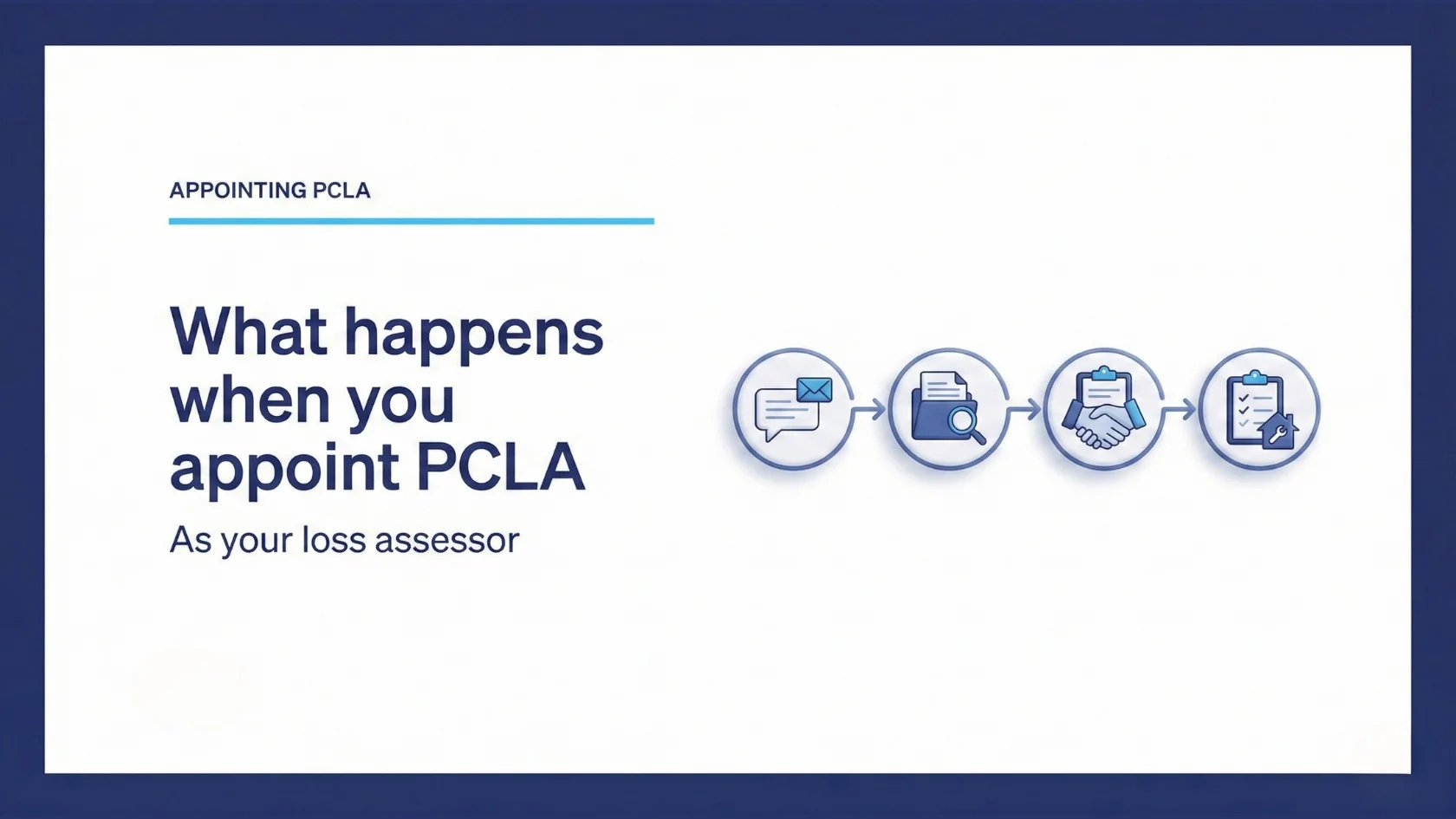
A loss assessor is appointed by you (the policyholder) to assess damage, prepare the claim presentation, and negotiate with the insurer.
In the UK, this can be especially useful when:
- the insurer disputes causation (wear and tear vs insured event);
- the scope of reinstatement is unclear or incomplete;
- the claim has multiple moving parts (drying, strip-out, specialist reports, contractor sequencing);
- communication is fragmented between insurer, loss adjuster, and contractors.
PCLA is an independent loss assessor and is authorised and regulated by the Financial Conduct Authority.
Where appropriate, PCLA can provide a no-obligation survey and an evidence-led view of what is realistic to challenge and what is likely to remain excluded.
If you are still deciding whether professional support is worthwhile for your situation, use the decision guide rather than relying on generic rules of thumb.
Learn more:
Case snapshots: when a “no” turned into a fairer outcome
Case snapshot 1
- Claim type: Escape of water in a semi-detached property.
- Insurer position: Reduced scope on the basis of “limited affected area”.
- What changed: Independent scope and reinstatement specification clarified necessary strip-out and making-good.
- Outcome: Revised scope agreed and settlement updated.
Case snapshot 2
- Claim type: Storm damage affecting roof and internal finishes.
- Insurer position: Decline citing “wear and tear / maintenance”.
- What changed: Evidence pack plus professional opinion distinguishing storm-related failure from gradual deterioration.
- Outcome: Causation position reviewed and claim progressed on an insured basis.
Case snapshot 3
- Claim type: Kitchen fire damage and smoke contamination.
- Insurer position: Reduced valuation and disputed replacement items.
- What changed: Itemised inventory, like-for-like pricing, and clearer contamination scope.
- Outcome: Valuation dispute narrowed and settlement improved.
FAQs
My home insurance claim was rejected. What can I do?
Start by asking the insurer to confirm the exact policy clause and the factual basis for the decision, then respond point-by-point with a clear evidence pack. If the claim team will not resolve it, use the insurer’s complaints process, then consider FOS if needed.
Is a reduced offer the same as a rejected claim?
No. A reduced offer usually means the insurer accepts some aspect of the claim but disputes scope, causation, or valuation. The response is often about itemised scope and evidence, not whether the claim exists at all.
How long do I have to go to the Financial Ombudsman Service?
FOS time limits depend on the circumstances, but a common rule is that you refer within six months of the insurer’s final response letter.
Should I accept the insurer’s first offer?
It depends on whether the scope and valuation reflect what is genuinely required to reinstate. If you need a structured way to assess this, use the dedicated guide.
Learn more: Should you accept your insurer’s first offer on a property damage claim?
Does the FCA say anything about how insurers should handle claims?
Yes. FCA rules (ICOBS 8.1.1R) require insurers to handle claims promptly and fairly, provide appropriate information on progress, and not unreasonably reject claims.
The FCA also publishes findings on claims handling practice across the market.
Optional next step: get a second opinion on a reduced or rejected claim
If you have a decision letter (or a reduced settlement schedule) and you want to know whether the insurer’s position is likely to be firm or whether it is worth challenging with better evidence and clearer scope, a second opinion can be useful.
PCLA provides independent loss assessing support and is FCA-regulated. Speak to us today and get a second opinion on a reduced or rejected claim.