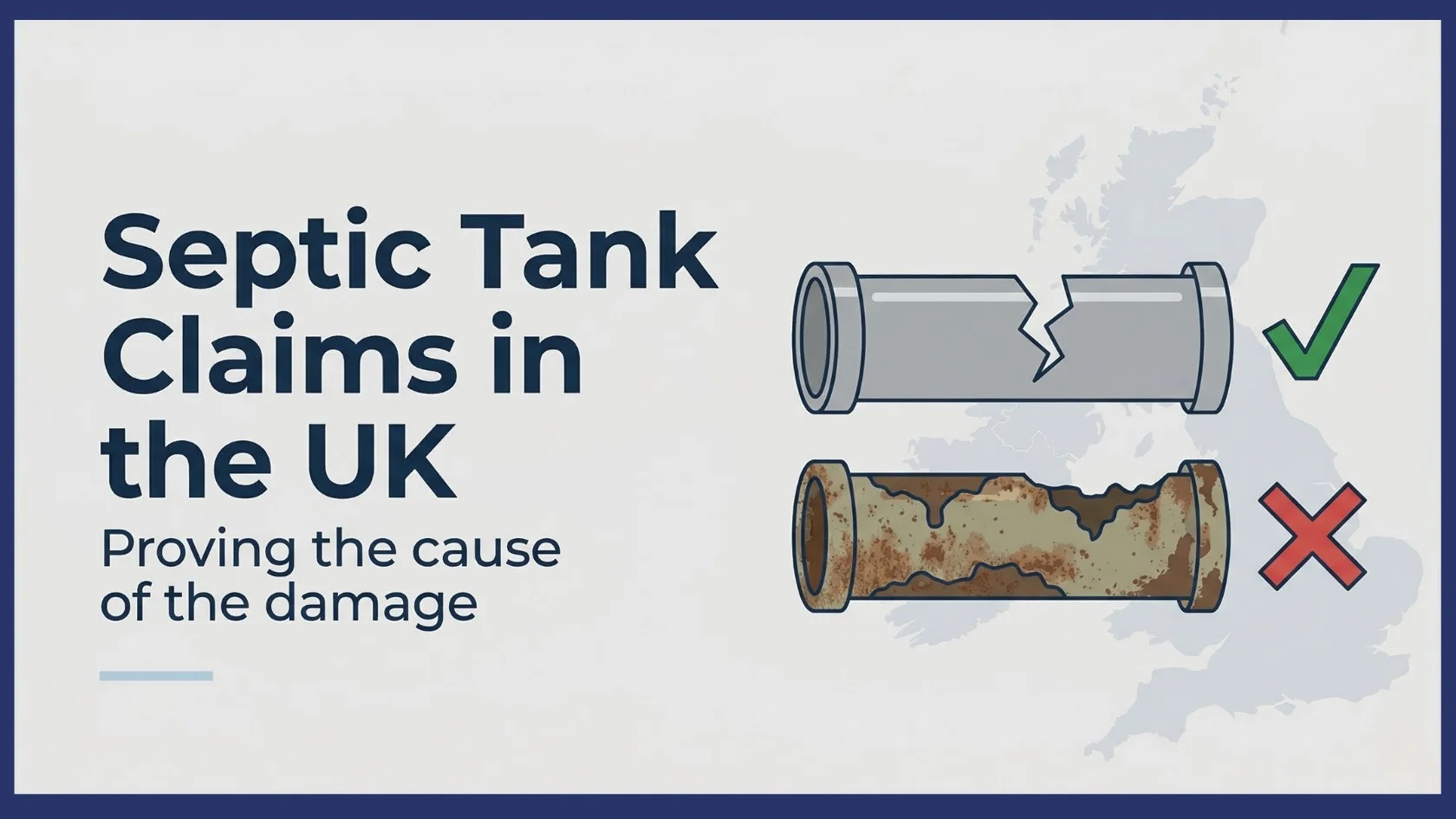
Septic tank problems can be expensive, disruptive, and difficult to sort out. This guide explains what may be covered, what evidence matters, why claims are often disputed, and what to do next if your insurer pushes back.
Remember: Not every septic tank issue is insured.
The outcome often depends on policy wording, the cause of damage, and the quality of the evidence.
See where septic tank wording may appear in a policy and what types of damage are commonly disputed.
Understand why weak reports, missing records, or unclear timelines can derail a claim.
Learn what to check, what to challenge, and when to escalate the dispute.
Not every septic tank issue is insured. Some claims succeed. Some fail.
Most turn on one central question: what caused the damage?
Not sure whether your policy covers you?
Ask PCLA to review your policy.
The claim is not just about whether the system failed. It is about which part failed, how it failed, and whether the policy responds to that cause of loss.
In simple terms, a septic system may include the tank itself, internal components such as baffles, connected pipework, and sometimes a soakaway or drainage field. Insurers may treat those parts differently.
Septic tank claims are often difficult because the system is underground and the original cause may no longer be obvious by the time the problem is discovered.
The important question is not only “what failed?” but “why did it fail?”
Tank: the main underground chamber.
Baffle: internal component that can fail or become displaced.
Pipework: inlet, outlet, and connected underground services.
Drainage field / soakaway: often the most expensive part of the remedial works.
Sometimes. Cover may exist, but it depends on the wording of the policy and the facts of the case.
Underground services wording, accidental damage wording, or policy wording that specifically names septic tanks or cesspits.
Sudden accidental physical damage linked to an identifiable insured event and supported by evidence.
Wear and tear, gradual deterioration, poor maintenance, pre-existing damage, or excluded components.
Read the Policy wording carefully:
Focus on the cause of damage, not just the repair bill. If the position is unclear, ask PCLA to review your policy wording.
This is the section that should do the most work. Most disputed claims turn on causation.
Overflow, failed baffle, odour, slow drainage, wet ground, failed inspection.
Sudden accidental damage or identifiable insured event.
Gradual deterioration, wear and tear, maintenance issue, or exclusion.
What often decides the outcome:
The quality of the technical evidence, especially a properly inspected and fully evidenced report.
| Two common types of dispute | Why this matters |
|---|---|
| Active causation dispute: the insurer says no insured event occurred at all. | Buried systems are often discovered late. |
| Characterisation dispute: both sides accept something failed, but disagree whether the damage was sudden or gradual. | Baffle failure can be especially contentious. |
| The date of damage may matter if insurers changed. |
When to get help.
If the cause of damage is likely to be disputed, speak to PCLA about a free policy review and 24-hour assessment.
Use a clear sequence. The aim is to protect safety, reduce further damage, and preserve evidence.
Key point:
Not every septic tank issue is insured. The outcome often depends on policy wording, the cause of damage, and the quality of the evidence.
Keep people and pets away if there is contamination and reduce water use where appropriate.
Photograph visible damage, access chambers, surrounding ground conditions, and any overflow or odour-related signs.
A proper inspection early on can make a significant difference later if the insurer disputes cause.
Report the issue without unnecessary delay and keep a written timeline with receipts and notes.
Avoid unnecessary permanent repairs before the issue is properly evidenced, unless urgent mitigation is needed to protect health, safety, or the property.
For a shorter step-by-step checklist, see PCLA’s emergency guide: https://pcla.co.uk/claims-management/emergency-steps-after-septic-tank-damage-uk/
If the damage is serious or the cause is unclear, speak to PCLA about a 24-hour assessment.
This is one of the biggest quality gaps in the current search results and one of the most useful sections for readers.
Use this as a quick reference before or during a claim.
Homeowners often weaken their own position at the start without realising it.
This is one of the most commercially and practically important sub-questions in the article.
Insurers may distinguish between the tank itself and the drainage field or soakaway. In practice, that can mean part of the claim is accepted while the most expensive part of the works is disputed.
A generic report saying the “system has failed” is often not enough. Where the drainage field is in issue, it may need its own technical assessment explaining condition, cause, and scope.
| Issue | May support a claim | May weaken a claim |
|---|---|---|
| Cause of damage | Evidence of a sudden event or clear physical damage. | Unclear timeline or signs of long-running deterioration. |
| Maintenance history | Receipts, desludging records, inspection notes. | No records or very late production of records. |
| Technical evidence | Independent report after proper inspection. | Brief contractor note with no clear causation analysis. |
| System component | Tank damage supported by wording and evidence. | Drainage field or soakaway excluded or poorly evidenced. |
Drainage and blocked-drain failures raise the same cause-and-evidence questions as septic claims (sudden event vs gradual deterioration vs maintenance); policy response depends on cause and wording; PCLA assesses the property damage connected to the failure and manages the claim the same way.
Insurers may rely on several familiar objections when they reject or narrow a septic tank claim.
Useful question to ask:
If your insurer is relying on wear and tear or lack of evidence, ask exactly what evidence would be needed to support a different conclusion.
A refusal is not always the end of the matter.
You need the insurer’s exact explanation before you can assess whether the decision is sound.
Check whether the real dispute is about causation, maintenance, scope of works, or timing.
Independent expert evidence can be decisive in septic tank claims where the cause is contested.
Keep the complaint focused on the wording, the evidence, and the specific point of disagreement.
If the matter remains unresolved, escalation to the Financial Ombudsman Service may be appropriate.
If your septic tank claim has been turned down, PCLA can challenge unfair decisions and review your next steps.
Even when liability is accepted, the next dispute may be about what the insurer has to pay for.
Sometimes a failed septic tank cannot simply be replaced like-for-like. Depending on the property and the applicable requirements, a more modern solution such as a sewage treatment plant may be needed instead. The insurer may argue that this involves betterment, meaning the replacement is an improvement rather than a straight replacement.
Similar issues can arise where drainage field work, testing, or associated compliance-related work adds significantly to the cost.
These arguments are fact-sensitive and should be handled carefully. The important point for the homeowner is that a claim can move from a liability dispute to a scope-of-works dispute even after the insurer has accepted some responsibility.
Where that happens, technical and regulatory input can make a material difference to the value and structure of the claim.
Appointed by the insurer to assess the claim on the insurer’s behalf.
Works for the policyholder and can help review wording, evidence, and disputed decisions.
That distinction matters in a technical septic tank claim because the homeowner may need independent help reviewing the policy wording, testing the insurer’s reasoning, and presenting the evidence clearly.
That does not mean every claim needs outside representation. Some are straightforward. But where the cause is disputed, the evidence is weak, or the insurer has already pushed back, independent support can help level the process.
For a fuller explanation, read ‘What Does a Loss Assessor Do?
It may be time to speak to PCLA if:
PCLA offers a free policy review and explains our fee and terms clearly before appointment. You can ask us to review your policy wording, assess the strength of the evidence, and present your position where the claim is disputed.
If you want PCLA to represent you, see our septic tank and drainage claims service (Northern Ireland) or our septic tank and drainage claims service in Scotland.
These are some of the questions homeowners most often ask when dealing with escape of water damage and insurance claims.
It may do, but the answer depends on the policy wording, the cause of damage, and the evidence available.
Sometimes. These claims often turn on causation. The key question is whether the evidence supports a sudden accidental event or gradual deterioration.
Not always. Some insurers distinguish between the tank and the drainage field, so that part of the claim may need separate technical evidence and careful review of the wording.
An independent expert report on a fully drained, properly inspected tank is often one of the most important pieces of evidence, alongside photos, maintenance records, and a clear timeline.
Ask for the reasons in writing, compare the decision with the wording and the evidence, and consider getting independent expert input.
Yes. Internal complaints and, where appropriate, the Financial Ombudsman Service may be available. The right response depends on why the claim was rejected.
That can lead to a dispute about betterment or scope of works. Even where the insurer accepts part of the claim, there may still be an argument about the cost of the required replacement solution.
Yes. PCLA acts as an independent claims management specialist for septic tank and drainage damage, working solely for the policyholder. We assess the damage, evidence the cause, manage the process with your insurer, and negotiate the settlement. Contact us before you notify your insurer or before you accept a settlement figure, while the evidence can still be shaped.

Greg Smyth is the founder of PCLA and has worked in insurance claims since 1999. With a degree in Building Surveying from the University of Reading and professional insurance qualifications, he brings technical property knowledge and practical loss assessing experience to PCLA’s guidance on property damage and insurance claims.
If you need more detail on one part of the process, these guides cover the next most common questions.