Do This First: Emergency Steps After Discovering an Oil Leak
- Stop the leak at source if safe to do so.
Turn off the oil supply valve at the tank. Do not attempt to move the tank or make structural repairs. If the leak is significant or you cannot isolate the supply, call your heating engineer immediately. - Protect the people in the house before you deal with the oil.
Heating oil and kerosene give off fumes that cause headaches, nausea and breathing irritation indoors. Open windows and doors to ventilate the affected rooms. Keep children and pets away from the spill and from any contaminated ground. Do not smoke and do not use naked flames near the area. Wear waterproof gloves and sturdy footwear if you have to go near the oil. If the fumes make the property uncomfortable to stay in, leave and call your insurer from outside. - Contain the spread.
Place absorbent materials (sand, cat litter, or proprietary oil absorbent granules) around the spill to slow surface spread. Do not wash oil away with water. This accelerates ground penetration and worsens contamination. - Do not clean up.
This is critical. Do not attempt to clean the contamination yourself before your insurer has been notified and a professional assessment carried out. DIY cleanup, even well-intentioned, can invalidate your claim. Insurers require professionally managed remediation. Premature cleanup also destroys the evidence base for your claim. Read more on this below. - Document everything before anything is moved.
Photograph the tank, pipework, filter bowl, valve, and any surrounding ground evidence: oil staining, dead vegetation, soil discolouration. Note the date and time. If there is a visible fracture, impact mark, or delivery connection point, photograph it in detail. - Check your oil usage records.
If your tank gauge shows an unexpected drop in level, note the reading now and retrieve any delivery records for the past 12 months. This information is directly relevant to your claim and to any dispute about when the leak occurred. - Notify your insurer.
Call your insurer’s claims line promptly and register the incident. Provide the date of discovery and a factual description. Do not give a detailed account of how long you think the leak may have been occurring, take advice before making that statement. - Notify the Northern Ireland Environment Agency (NIEA) if contamination may have reached a watercourse, drainage system, or a neighbour’s property.
You have a legal obligation to report oil pollution incidents that affect or may affect the surrounding environment. Failure to report can carry penalties independently of your insurance position. In Scotland, report to the Scottish Environment Protection Agency (SEPA). - Call PCLA before the loss adjuster visits.
Your insurer will appoint a loss adjuster to investigate and assess the claim. Oil leak claims have a high dispute rate, particularly around gradual damage exclusions. Before that assessment shapes your claim’s scope and value, speak to us. Read the section on loss adjusters below.
Need help now?
Call PCLA now on 028 9581 5318 in Northern Ireland, or 0141 461 2406 in Scotland.
PCLA operates across Northern Ireland and Scotland’s Central Belt, and can advise you at no cost before you commit to anything.
Oil Leaks in Northern Ireland: Scale and Exposure
Oil heating is not a marginal risk in Northern Ireland. It is the dominant heating fuel. 67.5% of Northern Irish homes rely on oil-fired central heating systems (Northern Ireland Housing Statistics 2022–23). Virtually every rural and suburban property in NI has an oil storage tank — typically polythene, steel, or bunded — connected to a boiler via underground or exposed pipework.
This creates a concentration of exposure that has no equivalent in Scotland’s Central Belt or England, where mains gas is dominant. When an oil claim goes wrong in NI — through rejection, undervaluation, or a disputed gradual damage exclusion — the financial consequences are severe. Remediation costs routinely run to tens of thousands of pounds. In cases where oil has migrated beneath foundations or into soil strata, six-figure costs are not uncommon.
Oil leak claims are also among the most frequently disputed. Insurers apply gradual damage exclusions aggressively in this area. The result is that a disproportionate number of legitimate oil claims — where a homeowner has suffered a genuine, sudden loss — are initially declined or offered settlements that do not reflect the full remediation cost.
What Home Insurance Covers for Oil Leaks
A standard home buildings insurance policy covers sudden and accidental escape of oil from a fixed heating system. This is the policy language on which your claim depends.
What a qualifying oil leak claim should cover:
- Cleaning and remediation of contaminated soil, including excavation and disposal
- Bioremediation treatment of affected ground
- Removal and reinstatement of flooring, subflooring, and affected structural elements
- Foundation repair where oil has migrated beneath the building
- Repair or replacement of damaged pipework and tank fittings
- Reinstatement of garden, patio, or external areas affected by contamination
- Odour management, including ventilation extraction units where required
- Environmental testing to confirm decontamination before reinstatement
- Alternative accommodation if the property becomes uninhabitable during remediation
- Third-party liability where contamination affects a neighbouring property
The scope of a well-managed oil claim is substantial. The financial difference between a first-look assessment and a fully scoped claim can be considerable — as the settled cases at the end of this guide demonstrate.
What Is Not Covered
Gradual leaks and long-term seepage
This is the most significant exclusion — and the most frequently invoked. Most policies cover sudden and accidental damage, not damage that has developed progressively through slow leakage, deterioration, corrosion, or lack of maintenance. Where an insurer concludes the oil escape was gradual rather than sudden, they will decline the claim or limit the settlement.
Poor maintenance
If your heating system has not been regularly serviced by a qualified OFTEC-registered engineer, the insurer can argue that inadequate maintenance contributed to the failure. Annual professional inspections are not just good practice — they protect the validity of your cover.
Tanks over a certain age without adequate protection
Some policies restrict cover for tanks beyond a specified age, particularly unprotected single-skin steel tanks. Check your policy schedule for any age or specification conditions.
Environmental cleanup beyond policy limits
Even where a claim is valid, policies carry financial caps on environmental remediation costs. Major contamination events can exceed standard policy limits, leaving the homeowner to fund the shortfall. PCLA reviews the full scope of remediation against policy limits as part of claim preparation.
Gradual damage that has been noticed and not reported
If there is evidence that an owner was aware of an oil smell, unexplained fuel consumption, or visible contamination and failed to act promptly, the insurer may argue the damage was allowed to develop rather than being reported at the point of discovery.
The Gradual Damage Exclusion: How It Is Challenged
The gradual damage exclusion is where the majority of oil claim disputes arise, and where the outcome most often depends on the quality of the evidence and the rigour of the challenge.
When an insurer declines an oil claim on gradual damage grounds, the response is not to argue around the policy wording in the abstract. The challenge has to be built around causation, timing, and evidence. The central question is not simply whether damage has developed over time — it is whether the insured loss was caused by a sudden, identifiable escape of oil, or by long-term leakage, deterioration, poor maintenance, or failure to act.
PCLA’s approach is to test whether the insurer’s conclusion is properly supported by the facts. Relevant evidence may include:
- The client’s discovery timeline: when the smell, staining, or symptoms were first noticed and what was done in response
- Oil usage records and tank gauge readings: an unexplained drop in tank level is consistent with a discrete escape event rather than gradual seepage
- Delivery records: particularly where the issue emerged following a recent refill, which can indicate overpressure, valve failure, or delivery-related damage
- OFTEC or heating engineer inspection findings: the engineer’s report on the condition of the tank, pipework, filter bowl, valve, and base
- Photographs of the tank and surrounding ground: evidence of the condition of the system at the time of discovery and whether any discrete failure point is identifiable
- Environmental and remediation reports: showing the likely source, spread pattern, and estimated timeframe of contamination
- Evidence of a discrete failure event: an impact, fracture, cracked fitting, faulty valve, failed seal, or pressure-related event
- Service and maintenance records: demonstrating the system was properly maintained and not previously showing signs of failure
- Absence of prior symptoms: evidence from the owner and from any previous inspections that there was no staining, odour, or vegetation damage before a specific date
- Specialist evidence distinguishing recent from historic contamination: environmental testing can indicate whether contamination is recent or of longer standing
The stronger the evidence of a sudden and identifiable escape, the stronger the basis for challenging a gradual damage decision.
This argument is not automatic. Not every oil claim can be taken past a gradual damage exclusion. If the evidence indicates long-term seepage, corrosion, lack of maintenance, or historic contamination, the claim may remain vulnerable regardless of the strength of the challenge. PCLA’s role is to test whether the insurer’s conclusion is properly supported; not to assert cover where the facts do not justify it.
When insurers rely on gradual damage exclusions in oil claims, the challenge is evidence-led. We examine whether the facts support a slow, progressive leak, or whether there is evidence of a sudden and identifiable escape of oil. Where the evidence supports the insurer’s position, we say so. Where it does not, we build the challenge on causation, timing, and the evidence record.
Your Legal Responsibility for Oil Contamination
Your insurance position and your legal position are separate. Even if your insurer disputes or declines your claim, your legal obligations remain in force.
You are legally responsible for containing and cleaning up oil contamination at your property. You are also responsible for contamination that migrates from your property to a neighbour’s land, a watercourse, a drainage system, or groundwater. Environmental regulation in Northern Ireland is enforced by the NIEA (Northern Ireland Environment Agency). Failure to contain and remediate an oil spill that affects the wider environment can result in prosecution and penalty independently of any insurance dispute.
This means that even where an insurer declines a claim, the obligation to remediate does not go away. In contested cases, PCLA advises on the interaction between the legal remediation obligation and the insurance dispute — the two tracks run in parallel and each affects the other.
If your contamination has affected or may affect a neighbouring property, inform your neighbour promptly and notify the NIEA. Document all steps taken. This record matters both to your insurance claim and to your legal position.
Why Oil Leak Claims Are Rejected
Around one in five UK home insurance claims is denied. For oil claims, the rate is higher. The most common grounds:
Gradual damage:
The insurer concludes the leak was not sudden but progressive — through slow seepage, corrosion, or deterioration. This is the dominant dispute in oil claims and is addressed in full above.
Poor maintenance:
No records of OFTEC-registered annual inspections. Visible corrosion or deterioration that was not addressed. Failure to act on prior symptoms such as unexplained fuel consumption or odour.
Inadequate documentation:
No photographs taken before cleanup. No record of when symptoms were first noticed. No delivery or consumption records to support the timeline. Without documentation, the insurer controls the narrative.
DIY cleanup before professional assessment:
If cleanup has begun before the insurer has been notified and a professional assessment carried out, the insurer can argue the evidence has been destroyed and the scope of contamination is unverifiable. This is one of the most avoidable claim failures.
Delayed notification:
Reporting the leak weeks or months after symptoms were first noticed gives the insurer grounds to argue the damage was not addressed promptly and may have been allowed to develop.
Contamination beyond policy limits:
Where remediation costs exceed the policy’s environmental cleanup cap, the insurer settles only to the limit. This is a coverage gap that needs to be identified at claim outset, not at settlement.
How to Make an Oil Leak Insurance Claim: Step by Step
Step 1: Contain and document
Follow the emergency steps above. Stop the source, contain surface spread, photograph everything, preserve evidence.
Step 2: Notify your insurer
Register the claim promptly. Provide the date of discovery and a factual account. Do not estimate how long the leak may have been occurring without taking advice first.
Step 3: Call PCLA
Before the loss adjuster visits, speak to us. We will inspect the property, review the evidence, and advise on the strength of your claim — including any gradual damage risk — before that assessment takes place.
Step 4: Professional environmental assessment
An environmental specialist surveys the contamination, takes soil samples, and establishes the extent and spread of the oil. This report is central to both the claim and any dispute about scope or causation.
Step 5: Loss adjuster assessment
The insurer’s loss adjuster will visit and produce a report forming the basis of their offer. If PCLA is appointed, we manage this process on your behalf and ensure the adjuster’s scope reflects the full remediation requirement.
Step 6: Remediation
Contaminated soil is excavated and removed. Bioremediation or other treatment is applied as required. Structural elements — floors, foundations, subflooring — are repaired and reinstated. Environmental testing confirms decontamination before reinstatement work is completed.
Step 7 — Settlement
Once scope and value are agreed, the insurer settles. PCLA remains involved until final payment is confirmed.
Who Is the Loss Adjuster, and Why It Matters for Oil Claims
When you register an oil leak claim, your insurer appoints a loss adjuster to investigate and value the damage. The loss adjuster works for the insurer. Their role is to assess the claim within the terms of the policy — but their commercial relationship is with the insurer, not with you.
In a straightforward claim, this distinction matters moderately. In an oil claim — where the gradual damage exclusion is in play, where contamination spread is difficult to visualise, and where remediation costs are high — it matters considerably. The loss adjuster’s conclusions on causation and scope directly determine the settlement.
A loss assessor works for you. PCLA prepares the claim, builds the evidence record, challenges any gradual damage decision on causation and timing, scopes the full remediation requirement, and negotiates the settlement. We sit on the opposite side of the table from the loss adjuster — representing your interests, not the insurer’s.
For the full explanation of how the roles differ: Loss Assessor vs Loss Adjuster vs Broker: Who Does What?
Remediation: What It Involves and Why Professional Management Matters
Oil contamination remediation is a specialist discipline. The scope depends on where the oil has travelled, what substrates are affected, and what environmental standards must be met before reinstatement can proceed.
Typical remediation stages:
- Initial survey and soil sampling: establishes the extent and depth of contamination and identifies the likely spread pattern
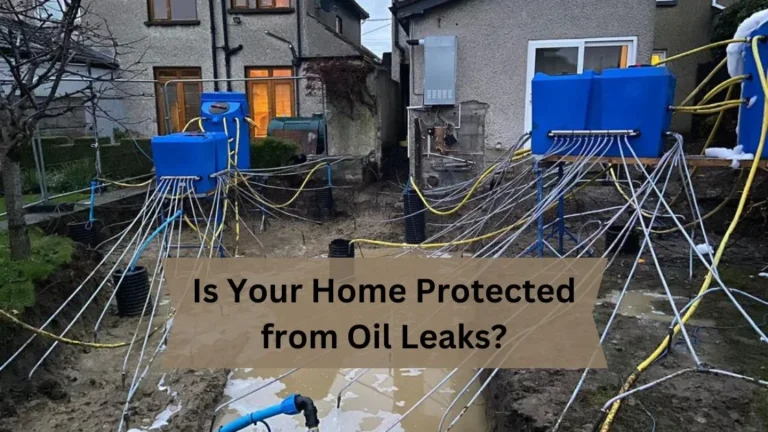
- Excavation: contaminated soil is dug out, removed from site, and disposed of in compliance with environmental regulations. In major cases this includes breaking out flooring, removing subflooring, and exposing foundations
- Bioremediation: where full excavation is not feasible or is supplemented, biological treatment breaks down residual hydrocarbons in situ
- Odour management: ventilation extraction units (VEUs) address oil vapour within the building during and after remediation
- Environmental testing: laboratory analysis confirms that contamination levels have been reduced to acceptable thresholds before any reinstatement work begins
- Reinstatement: replacement of excavated ground, structural repairs, restoration of flooring, paving, and garden areas
Why DIY cleanup invalidates your claim
Most home insurance policies specify that remediation must be conducted by qualified professionals. If cleanup has started before the insurer has been notified and a professional assessment carried out, the insurer can argue:
- The evidence has been disturbed or destroyed
- The scope of contamination before cleanup is not verifiable
- The cleanup does not meet the technical standard required by the policy
The insurer may reduce or deny the claim on this basis. Do not begin cleanup before taking advice. Emergency containment — placing absorbent materials to slow surface spread — is appropriate and expected. Active remediation is not.
PCLA works alongside remediation specialists and coordinates the claims and remediation tracks so that evidence is preserved, scope is properly recorded, and the insurer’s obligations are clear at every stage.
For the full remediation service — site survey, excavation management, bioremediation, and reinstatement — see: PCLA Oil Spill Remediation Services.
Oil Leak Claims in Northern Ireland: Settled Cases
The following cases were managed by PCLA. Each illustrates how oil contamination develops and what professional claims management recovers.
Bangor: Oil spread beneath patio
An oil leak was discovered and found to have spread under a patio area. Contaminated soil was excavated and removed. Bioremediation was applied to affected ground, with full reinstatement of paving and external areas on completion. Settled: £53,765.
Dungannon: Oil tracked beneath foundations
The homeowner noticed a persistent smell of oil inside the house. Inspection of the boiler and tank was followed by soil sampling. Testing established that oil had spread beneath the property. Foundations were excavated to allow access for bioremediation treatment. Full structural and ground reinstatement followed. Settled: £72,356.
Glenavy: Major subsurface contamination
An oil smell was the first indicator. Soil samples confirmed contamination had spread significantly beneath the home. The scope required foundation excavation, extensive bioremediation, and full reinstatement of affected structural elements and ground. This was one of the larger domestic oil claims PCLA has managed. Settled: £109,203.
These cases share a pattern: the visible symptom was minor — a smell, a gauge reading, a stained patch of ground — and the actual contamination was substantially larger. Each claim required thorough scoping to capture the full remediation requirement, and each would have settled for significantly less without professional representation.
Protecting Your Claim: Annual OFTEC Inspections
An annual inspection by an OFTEC-registered heating engineer does two things. First, it reduces the likelihood of a leak by identifying deteriorating pipework, corroded tank bases, failing valves, and worn fittings before they fail. Second, it provides the documented maintenance record that insurers examine when a claim is submitted.
An insurer looking to apply the gradual damage exclusion, or to argue poor maintenance, is looking for the absence of this record. An unbroken inspection history directly undermines both arguments.
PCLA recommends annual OFTEC inspections as a practical claim protection measure, not only as general maintenance advice. If you do not have records of recent inspections, obtaining one before a claim arises is still better than no record at all.
For more detail on tank cover, garden tank leaks and what insurers ask for, see our supporting guide: Garden Oil Tank Leaks: What UK Homeowners Need to Know About Insurance Claims
How PCLA Handles Oil Leak Claims
PCLA is an independent loss assessing firm. We work for policyholders — not insurers. Our team includes qualified building surveyors and certified insurance practitioners with specialist experience in oil leak claims across Northern Ireland.
When you appoint PCLA for an oil leak claim, we:
- Inspect the property and review all available evidence before the loss adjuster visits
- Advise on the strength of your claim and any gradual damage risk — before those conclusions are reached by the insurer
- Prepare a full schedule of all recoverable losses: remediation, structural repair, reinstatement, accommodation, and third-party liability where applicable
- Review your policy in full, including the environmental cleanup cap and any conditions specific to your tank type or heating system
- Challenge gradual damage decisions with a structured evidence-led response: causation, timing, the client’s discovery timeline, oil usage records, delivery history, OFTEC findings, environmental testing, and contamination spread analysis
- Coordinate with environmental specialists and remediation contractors to ensure evidence is preserved and scope is properly recorded
- Negotiate the settlement directly with the loss adjuster and insurer
- Manage the claim through to final payment
Our fee: no-win, no-fee loss-assessing services are available for most domestic property damage claims. PCLA’s standard fee is 10% of the settlement plus VAT. The rate on an individual claim can be higher or lower depending on its size and complexity, and your exact fee is agreed with you in writing before you appoint us. No upfront cost. No fee if no settlement is recovered. No hidden charges.
What If Your Oil Claim Has Been Declined?
If your insurer has declined your claim — most commonly on gradual damage grounds — the decision is not necessarily final.
Request the insurer’s written declinature letter, which should set out the precise policy wording relied on, the evidence supporting their conclusion, and the reasoning applied. This is the document PCLA works from when building a challenge.
A well-evidenced counter-position — addressing causation, timing, the discovery timeline, usage and delivery records, inspection history, and environmental findings — reverses a significant proportion of oil claim declinatures. Where it does not, you have the right to refer your complaint to the Financial Ombudsman Service (FOS), which provides free, independent resolution. You have eight weeks from the insurer’s final response before you can refer.
Call PCLA to discuss your position. A declined claim is a starting point for assessment, not a final outcome.
Frequently asked questions about oil leak insurance claims
Does home insurance cover oil leaks in Northern Ireland?
Yes, if the leak was sudden and accidental. A standard buildings insurance policy covers escape of oil from a fixed heating system where the cause was a sudden, identifiable event — not long-term seepage or deterioration. The cover extends to remediation of contaminated soil, structural repairs, and alternative accommodation if the property is uninhabitable during works.
What is the gradual damage exclusion and how does it affect my oil claim?
Most home insurance policies cover sudden and accidental damage. They exclude damage that has developed gradually — through slow leakage, corrosion, or deterioration over time. Insurers apply this exclusion to oil claims where they conclude the escape was progressive rather than sudden. It is the most common ground for oil claim rejection or reduction.
My insurer says my oil leak is gradual damage — can I challenge it?
Yes, in many cases. The challenge is built on causation, timing, and evidence. The question is whether the facts point to a sudden, identifiable escape of oil, or to long-term leakage and deterioration. Relevant evidence includes oil consumption records, delivery history, OFTEC inspection findings, tank and pipework photographs, environmental testing, and the client’s discovery timeline. PCLA builds these challenges systematically. Where the evidence supports a sudden escape, the insurer’s gradual damage position can often be reversed. Where the evidence points to long-term deterioration, the claim remains vulnerable.
Who is legally responsible for cleaning up an oil spill at my property?
You are, regardless of your insurance position. Legal responsibility for oil contamination — including contamination that migrates to neighbouring property, watercourses, or groundwater — rests with the property owner. The Northern Ireland Environment Agency (NIEA) enforces environmental regulation and must be notified where contamination may affect the wider environment. Your insurance claim and your legal obligation run in parallel.
Can I clean up the oil spill myself before the insurer sends someone?
No — not beyond basic containment. Emergency steps such as placing absorbent materials to slow surface spread are appropriate and expected. Active remediation — digging, removal of contaminated soil, washing or chemical treatment — should not start before the insurer has been notified and a professional assessment has taken place. Premature cleanup destroys the evidence base and may invalidate your claim.
How much does oil leak remediation cost?
Costs vary widely depending on the extent of contamination and the ground conditions. Minor surface spills may cost £8,000 to £20,000 to remediate. Where contamination has spread beneath the property, penetrated soil strata, or affected foundations, costs typically run between £50,000 and £150,000. Major cases — such as the Glenavy claim settled by PCLA at £109,203 — sit at the higher end of that range. Early detection and prompt reporting limit the extent of spread and, therefore, the cost.
What happens if oil contamination spreads to my neighbour's property?
You may be liable for the cost of remediating your neighbour’s land and any resulting damage to their property. Most home insurance policies include third-party liability cover with financial limits. If contamination has reached or may reach adjacent land, notify your neighbour, inform the NIEA, and contact PCLA. This exposure needs to be identified and managed as part of the claim.
Do I need to notify the Northern Ireland Environment Agency (NIEA) about an oil spill?
You should notify the NIEA where contamination has affected or may affect a watercourse, drainage system, groundwater, or neighbouring land. Failure to report a reportable pollution incident carries independent legal risk. PCLA advises on this as part of the claims process.
How long does an oil leak insurance claim take?
Oil claims are complex and typically take longer than standard property claims. A case involving surface contamination only may resolve in a matter of months. A major claim requiring foundation excavation, bioremediation, environmental certification, and full structural reinstatement can take twelve months or more. PCLA coordinates the remediation and claims tracks concurrently to minimise delay.
Is it too late to appoint a loss assessor if my oil claim has already been declined?
No. The best time to appoint PCLA is before you notify your insurer, or before you accept a settlement figure, while the cause and the scope of remediation can still be established properly. If you have already received a written declinature, contact us. We will review the insurer’s reasoning, assess whether the gradual damage or maintenance position is properly supported, and advise on the strength of a counter-challenge.
Get Help With Your Oil Leak Claim
PCLA handles oil leak and oil spill insurance claims across Northern Ireland and Scotland’s Central Belt. Our team includes qualified building surveyors and certified insurance practitioners. Property Claims Loss Assessors Ltd, trading as PCLA, is a claims management company authorised and regulated by the Financial Conduct Authority, FRN 933781.
If you have discovered an oil leak, or if your claim has already been disputed or declined, call us before you take another step. Northern Ireland: 028 9581 5318. Scotland: 0141 461 2406.
There is no cost for the initial conversation and no obligation to proceed.