
Kilmarnock Loss Assessors by PCLA
Thinking about making a home insurance claim?Speak to an independent loss assessor first.
Get clear independent advice before moving forward. We explain your options, assess the damage, and help you handle the claim properly from the start.
Request your free claim review today.
Call 0141 461 2406Remember, we handle the hassle, you keep the payout.
Loss Assessors in Kilmarnock. Get Independent Help with Your Home Insurance Claim
Have you suffered property damage at home e.g. a burst pipe, a water leak, a storm event, a fire, and you're not sure what to do next? You know you need to make an insurance claim. You may have already spoken to your insurer, or you may be wondering whether you should call them at all before getting independent advice.
Most homeowners in Kilmarnock and across Ayrshire do not realise they can appoint their own expert at this stage. Before they meet the insurer's loss adjuster, before an assessment is made, and before they commit to anything. That is what PCLA does. We're independent loss assessors. Our surveyors attend properties in Kilmarnock and across East Ayrshire in person. Our job is to make sure your claim is properly prepared from the start.
Fair claims start here. Thinking about making a claim?
Speak to PCLA on 0141 461 2406.
What Is an Independent Loss Assessor?
Your insurer appoints a loss adjuster to assess your claim. Their role is to assess the claim for the insurer. They are not appointed to prepare your claim on your behalf or advocate for the highest fully evidenced settlement.
An independent loss assessor works the other way around. We are appointed by you, act exclusively for you, and our job is to ensure your claim is documented fully and presented in a way that reflects the true extent of your loss.
We are not adversarial. A well-prepared claim, submitted by a qualified surveyor with a full costed repair schedule and supporting technical evidence, is simply harder to dispute than a self-reported one.
The earlier you involve us, the more we can do. The best time to call is before you notify your insurer, or before you accept a settlement figure, while the evidence and the scope of the claim can still be shaped. A short call at that point costs nothing and does not commit you to anything.
What we do, in three steps
PCLA acts for the homeowner, not the insurer. Our work on a claim covers three things:
1. Assess the claim.
We attend your property, review the cause and extent of the damage, and look at the policy position. We tell you what the claim is likely to involve, what your policy covers, and where the points of difficulty are likely to be.
2. Evidence the damage.
We document the damage with photographs, moisture readings, and technical reports. Where hidden damage is suspected — under floors, behind plasterboard, inside wall cavities — we carry out moisture mapping and trace and access work to establish the true extent.
3. Negotiate the settlement.
We prepare and submit the claim, handle all correspondence with your insurer and any loss adjuster they appoint, respond to queries, and negotiate the settlement on your behalf.
You do not manage paperwork, meet the loss adjuster, or negotiate the figure. We handle that for you.
A Kilmarnock escape of water claim, settled at £14,600
A homeowner in Kilmarnock contacted us after a burst pipe in their upstairs bathroom caused water to escape into the property over a period of time before being discovered. By the time the source was identified, water had travelled beyond the bathroom, down through the floor, and into the rooms below. The damage extended into the living room and the hallway on the ground floor.
The initial appearance of damage in any escape of water situation rarely reflects the full picture. Water follows the path of least resistance — under floorboards, through ceiling voids, behind skirting boards, and into adjoining rooms. A claim assessed only on what is visible at first inspection often misses the full extent of reinstatement required.
We attended the property, carried out a moisture survey of the affected rooms, documented the damage room by room, and prepared a comprehensive schedule of works covering the bathroom, the living room ceiling, the hallway, and the associated decoration and flooring reinstatement.
The claim was settled at £14,600.
Case details shared with permission of the policyholder.
Ready to Start Your Claim?
Tell us what happened.
We’ll call you back within 30 minutes and explain what you’re entitled to under your policy.
No obligation. No upfront fee.
You don’t need to deal with the insurer. That’s what we’re here for.
Why home insurance claims in Kilmarnock can become complicated
Kilmarnock has a varied housing stock. Pre-1919 sandstone tenements and traditional terraced housing sit alongside post-war estates and newer private developments. Each property type can raise its own set of considerations when a claim is made.
Older properties and ageing pipework.
Many homes in Kilmarnock are pre-war or pre-1919. Original or partially replaced pipework, suspended timber floors, lime plaster, and older roofing materials can all complicate a claim. Where a leak has developed slowly through ageing pipework, an insurer may raise the question of whether the damage is sudden — and therefore covered — or gradual, which may be treated differently under the policy.
Tenement and shared-building leaks.
Tenement buildings carry specific complications. Where a leak originates in an upstairs flat, in common pipework, or in a shared roof, responsibility for the source can sit with a different party from the responsibility for repairing the damage in your home. Industry data from Direct Line suggests that around one in four escape of water claims in flats involve a neighbouring property — the situation is not unusual, but it can be complex to navigate.
Storm damage to traditional roofs and chimneys.
Slate roofs, stone chimney stacks, and traditional rendering can all be vulnerable to wind and driving rain damage. Storm damage claims often raise the question of whether the damage was caused by a storm event or was pre-existing. Therefore. establishing the cause clearly with date-stamped evidence is important.
Scope of reinstatement.
Even where a claim is accepted, the scope of works can become a point of difference. Traditional materials, lime plaster, matching slate or stonework, and specialist repair methods can add complexity that a standard insurer-prepared schedule may not capture in full.
None of this means your insurer will act unfairly. It means that a properly prepared claim, with the right evidence, an accurate scope, and a clear policy position, is far easier to settle without dispute.
When to contact PCLA
Ideally before the loss adjuster visits.
Appointing PCLA early means we carry out our own inspection and survey before any assessment is made on behalf of your insurer. The evidence base for the claim is set at this point — early appointment gives the strongest foundation.
If your insurer has already inspected.
You can still appoint PCLA. A settlement offer is not final until you have accepted it. We can review the offer, carry out further investigation where needed, prepare an independently costed schedule of works, and negotiate before you make any decision.
If the claim is delayed, reduced, or refused.
If your claim is taking too long, the offer does not reflect the extent of the damage, or you have received a refusal on grounds such as gradual damage or wear and tear, contact us and we will review the position.
If hidden damage has emerged later.
If additional damage has been discovered during strip-out or drying — for example, saturation beneath floors that was not picked up at the initial inspection — we can manage the supplementary claim.
Call PCLA: 0141 461 2406.
PCLA operates on a No Win, No Fee basis for loss assessing services. There is no upfront cost, and no fee is payable unless your claim is settled. Our fee is a percentage of the agreed settlement, confirmed in writing before any work begins.
There is no obligation from an initial call.
Loss Assessors and Loss Adjusters: What's the Difference?
Many Kilmarnock homeowners search for a "loss adjuster" when what they need is a loss assessor. The terms are used interchangeably, but the distinction matters.
PCLA are loss assessors. We have no commercial relationship with any insurer. We are paid only when your claim settles, and only as a percentage of what you receive.
What Makes PCLA Different?
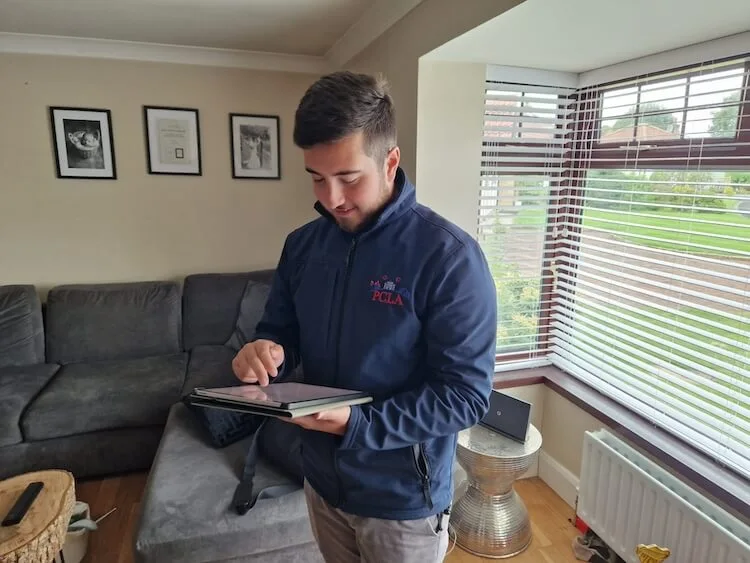
Claim types we handle in Kilmarnock
PCLA handles the full range of home insurance claims in Kilmarnock and across East Ayrshire, including:
Whether your claim involves a single room or affects the whole property, we manage the process from first inspection to final settlement.
Areas We Cover Around Kilmarnock and Ayrshire
We cover Kilmarnock, Ayrshire, and the surrounding towns, including:
Kilmarnock (all districts), Ayr, Irvine, Troon, Prestwick, Stewarton, Galston, Cumnock, Mauchline, Maybole — and across the wider Ayrshire region:
We are not a franchise operation. The assessor who visits your property is a PCLA employee.
Get Help Today
Questions People Ask Before Getting Help With a Claim
Thinking about making a claim? Speak to PCLA first
If you have suffered property damage at home in Kilmarnock and you are not sure what your claim involves, contact PCLA. We give homeowners their own expert before the insurance claim begins — assessing the claim, evidencing the damage, and negotiating the settlement, so the claim is properly prepared from the start.
Call: 0141 461 2406.
No Win, No Fee. No upfront cost. No obligation from an initial call.
Call 0141 461 2406For our wider Scotland service, see our Scotland loss assessor page →.
About PCLA
PCLA are Independent Loss Assessors and Claims Managers who work solely for you—the policyholder.
We help homeowners and business owners across Kilmarnock deal with sudden damage, water leaks, fires, and insurance complications. If you’ve suffered loss or disruption, we take the pressure off.
With over 25 years’ experience and a team of qualified surveyors, we handle every stage of the claims process—assessment, paperwork, negotiation, and repair coordination—so you don’t have to.
We act on your behalf to secure the full settlement you're entitled to under your policy. No chasing calls. No second-guessing the process. Just clear, expert support from start to finish.
We make insurance claims easier, faster, and fairer.
Schedule an appointment