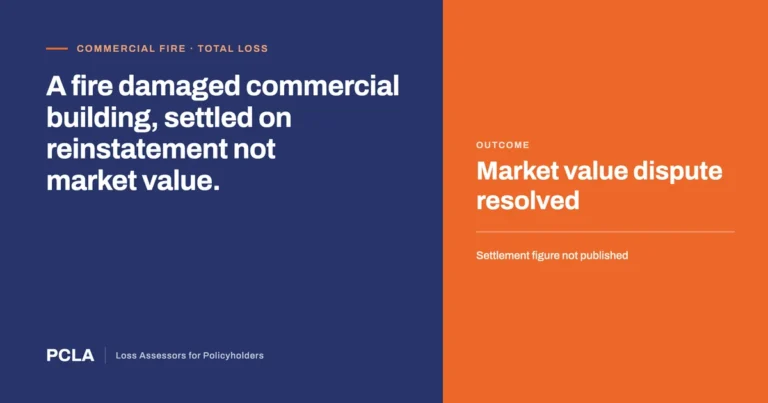
A commercial property owner appointed PCLA after a serious fire caused extensive damage to a vacant building in Scotland.
At the time of the fire, the property was already being marketed for sale. This became central to the claim because the policy contained wording that affected how the loss could be assessed where a building was offered for sale on the open market.
The insurer’s initial settlement position did not properly reflect the policyholder’s entitlement under the policy wording and evidence available.
The claim involved forensic investigation evidence, structural engineering evidence, valuation evidence and detailed review of the policy wording and settlement basis. Following PCLA’s involvement, the claim was resolved by way of a negotiated cash settlement.
For confidentiality reasons, the settlement figure is not published. The important point is that PCLA challenged the insurer’s assumptions around market value, residual value and total loss, and negotiated a settlement that reflected the reinstatement position and the commercial reality of the damaged building.
PCLA Scotland acted for the policyholder, not the insurer.
Case Summary
| Detail | Information |
|---|---|
| Property type | Vacant commercial building |
| Location | Scotland |
| Claim type | Commercial fire damage |
| Property status | Being marketed for sale at the time of the fire |
| Main issue | Market value settlement dispute |
| Key evidence | Forensic investigation, structural engineering evidence and valuation evidence |
| Main dispute | Whether the insurer’s valuation reflected the total loss status and true residual value of the building |
| Outcome | Negotiated cash settlement agreed |
This Case May Be Relevant If
You may want to have your commercial fire damage claim in Scotland reviewed if:
- your insurer has proposed a market value settlement;
- the property was vacant, for sale, or not being reinstated;
- there is a dispute over residual value;
- the insurer says the damaged building or site still has significant value;
- the building may be a total loss;
- the claim involves engineers, valuers or forensic investigators;
- the insurer’s offer does not appear to reflect the full commercial impact of the fire;
- you are unsure whether the proposed settlement reflects the policy wording.
A review can help you understand whether the insurer’s offer properly reflects the policy, the evidence and the practical reality of the damaged property before you agree settlement.
Key Terms in This Claim
Reinstatement means repairing, rebuilding or replacing the damaged property, subject to the policy terms, limits and exclusions.
Diminution in Market Value means the reduction in the property’s value caused by the damage.
Residual value means the remaining value of the damaged building or site after the fire.
Total loss means the damage is so serious that repair is not practical, economic or reasonable, even if parts of the building are still standing.
These terms mattered because the insurer’s settlement position depended heavily on the property’s market value, the damaged building’s residual value and whether the building could sensibly be repaired.
Background to the Claim
The property was a vacant commercial building in Scotland. It had previously been used for commercial purposes but was no longer occupied at the time of the fire.
Before the incident, the owner had placed the property on the open market for sale.
After the fire, the building suffered extensive damage. There were immediate questions around:
- the cause and circumstances of the fire;
- the safety of the remaining structure;
- whether the building could be economically repaired;
- the value of the building before the fire;
- the value of the damaged property after the fire;
- the correct basis of settlement under the insurance policy.
This was not a straightforward repair claim.
The claim required input from forensic investigators, structural engineers, valuers and insurance professionals. It also required careful review of the policy wording because the fact that the property was up for sale affected how the insurer sought to calculate the loss.
PCLA regularly assists property owners with commercial fire damage claims where an insurer’s offer needs to be reviewed before settlement is agreed.
Why the Property Being Up for Sale Mattered
In many fire damage claims, the starting point is the cost of reinstating the building. Reinstatement usually means repairing, rebuilding or replacing the damaged property so that it is returned to an equivalent condition, subject to the policy terms and limits.
In this case, the position was more complicated because the property was already being offered for sale.
The policy wording included a clause dealing with loss of investment value. This applied where a building suffered insured damage while being offered for sale on the open market. In practical terms, it allowed the insurer to consider the reduction in sale price achieved by the policyholder as a result of the damage.
The policy also contained wording dealing with loss of market value where the policyholder elected not to repair or rebuild. This meant the insurer could look at the reduction in market value immediately following the damage, rather than approaching the claim only as a standard repair or reinstatement exercise.
That did not mean the insurer’s calculation could ignore the true extent of the damage or the commercial reality of the fire-damaged property.
The correct settlement still had to reflect the insured loss, the policy wording and the available evidence.
The dispute was not simply whether market value was relevant. The real issue was whether the insurer’s calculation properly reflected the damage, the condition of the building and the policyholder’s entitlement.
What Is Diminution in Market Value?
Diminution in Market Value, often referred to as DMV, is the reduction in the value of a property caused by damage.
In a fire damage claim, DMV usually involves comparing:
- the market value of the property immediately before the fire; and
- the market value of the property immediately after the fire.
The difference between those two figures is the diminution in value.
For example, if a commercial property was worth £900,000 before a fire and £350,000 after the fire, the diminution in market value would be £550,000.
That is a simplified example. In real commercial fire damage claims, the calculation is rarely that straightforward.
The valuation may need to consider:
- the physical extent of the fire damage;
- the condition of the remaining structure;
- whether the building can be safely retained;
- whether repair is practical or economic;
- demolition and debris removal costs;
- professional fees;
- statutory requirements;
- planning and development issues;
- purchaser risk;
- funding difficulty;
- reduced market demand;
- the remaining value of the site.
A damaged building may still have some residual value, particularly where the land or development potential has value. However, insurers can sometimes place too much weight on residual value and not enough weight on the practical reality of the damaged property.
That was one of the central issues in this claim.
Why the Insurer Considered a Market Value Settlement Basis
The insurer relied on the fact that the property was being marketed for sale at the time of the fire.
Their position was that, because the policyholder was already selling the property, the relevant loss should be assessed by looking at the effect of the fire on the property’s value or sale price.
From an insurer’s perspective, this type of argument may be used where:
- the policyholder was not intending to occupy the building;
- the property was already on the open market;
- reinstatement works had not been carried out;
- the insurer considered that the damaged building or site still had residual value;
- the insurer said the claim should reflect market loss rather than full rebuilding cost;
- the insurer argued that the policyholder should not recover more than their actual financial loss.
There can be a legitimate basis for considering market value where the policy wording supports it.
However, a market value approach still needs to reflect the scale of the damage, the available evidence and the policyholder’s actual loss.
The question was not whether market value could be considered. The question was whether the insurer’s calculation properly reflected the policy wording, evidence and true commercial impact of the fire.
The Insurer’s Initial Offer
The insurer’s initial offer was lower than the policyholder was entitled to.
Although the claim was being considered by reference to market value, the insurer’s position did not properly reflect the extent of the fire damage or the practical effect on the building.
In a claim of this type, the insurer may try to reduce the settlement by arguing that the damaged property still has significant residual value.
If the insurer places a high value on the damaged building or site, the reduction in market value becomes smaller. This can lead to an offer that falls short of the policyholder’s true entitlement.
PCLA challenged the assumptions behind the insurer’s proposed settlement.
The main issue was not whether market value was relevant. The issue was whether the insurer had properly assessed the damaged building, the residual value and the full consequences of the fire.
If you have a query relating to a commercial property damage claim, contact our Loss Assessor’s in Glasgow who will be able to offer immediate support and advice.
Evidence Used in This Claim
The claim required several forms of evidence, including:
- forensic investigation evidence on the cause and circumstances of the fire;
- structural engineering evidence on the condition of the remaining building;
- valuation evidence on pre-loss and post-loss market value;
- review of the policy wording and settlement basis;
- assessment of whether the building could be economically repaired;
- consideration of residual site or building value;
- reinstatement and total loss analysis.
This evidence was important because the claim could not be resolved from photographs alone.
The insurer’s settlement position depended on technical, valuation and policy issues. Those issues needed to be brought together in a clear and structured way before the claim could be properly negotiated.
Expert Evidence Was Required
Forensic investigators were involved to consider the cause and circumstances of the fire.
This was important because the insurer needed to be satisfied that the loss fell within the scope of cover and that no exclusion or policy condition prevented recovery.
Structural engineers were also involved because the building had suffered serious damage. Their evidence was central to establishing whether the remaining structure could safely and economically be retained, repaired or reinstated.
Valuation evidence was required because the policy wording made the property’s value and sale position directly relevant to the claim.
PCLA’s role was to bring the technical, valuation and policy issues together and present the claim in a way that properly reflected the policyholder’s entitlement.
This included reviewing:
- the insurer’s proposed settlement basis;
- the forensic investigation position;
- the engineering evidence;
- the extent of fire damage;
- the condition of the remaining structure;
- whether the building was capable of economic repair;
- the likely reinstatement position;
- the pre-loss value of the property;
- the post-loss value of the damaged property;
- the insurer’s assumptions on residual value.
Establishing That the Building Was a Total Loss
A major part of the claim was showing that the building was effectively a total loss.
A building does not have to be completely destroyed to be treated as a total loss. In insurance terms, a property may be a total loss where the damage is so extensive that repair is not practical, economic or reasonable.
In this case, the evidence showed that the fire had caused damage of such severity that the building could not sensibly be treated as a simple partial repair claim.
That was important because, if the insurer treated the property as only partially damaged, they could argue for a lower settlement.
By demonstrating that the building was a total loss, PCLA was able to challenge the insurer’s assumptions and push the claim towards a more appropriate outcome.
The reinstatement position was also relevant.
Even though the insurer had sought to approach the claim by reference to market value because the property was being offered for sale, the extent of the damage and the cost and practicality of reinstatement still had to be considered properly.
In claims like this, the reinstatement position can have a direct bearing on the true value of the damaged property.
A purchaser looking at a fire-damaged building will not simply look at the land or remaining walls. They will also consider the cost, risk and practicality of making the property usable again.
Why the Insurer’s Offer Was Too Low
The insurer’s offer did not properly reflect the real impact of the fire.
Where a fire-damaged commercial property is valued after a loss, residual value can become a major point of dispute. If the insurer places too high a value on the damaged building or site, the reduction in market value becomes smaller. That can lead to a settlement that is too low.
In this claim, the insurer’s approach did not give enough weight to the fact that the building was effectively a total loss.
A potential purchaser of a seriously fire-damaged commercial building may take account of:
- structural uncertainty;
- demolition and clearance costs;
- abnormal reinstatement costs;
- professional fees;
- statutory requirements;
- planning and development risk;
- contractor risk;
- delay;
- lending issues;
- reduced market demand;
- the possibility that repair is not economic.
Those factors can materially reduce the value of a damaged property.
If they are not properly considered, the insurer’s offer may appear reasonable on paper but still fail to reflect the true commercial loss.
PCLA challenged the assumptions behind the insurer’s valuation and advanced the claim on the basis that the building’s total loss status had to be reflected in the settlement.
What PCLA Did
PCLA acted for the policyholder, not the insurer.
Our role was to review the insurer’s position, assess the relevant policy wording and challenge the proposed settlement where it failed to reflect the policyholder’s entitlement.
PCLA assisted by:
- Reviewing the policy wording and proposed basis of settlement.
- Considering the effect of the property being marketed for sale.
- Reviewing forensic, engineering and valuation evidence.
- Assessing whether the building was capable of economic repair.
- Challenging assumptions around residual value.
- Presenting the case that the building was a total loss.
- Negotiating a cash settlement on behalf of the policyholder.
The claim required more than a repair estimate. It required policy wording, technical evidence and valuation evidence to be brought together in a clear and structured way.
The Outcome
Following PCLA’s involvement, the claim was resolved by way of a negotiated cash settlement.
For confidentiality reasons, the final settlement figure is not published.
The important point is that the settlement reflected the reinstatement position and total loss status of the building.
This was an important distinction. Although the insurer had sought to approach the claim by reference to market value because the property was being offered for sale, the evidence showed that the building had suffered such extensive damage that it had to be treated as a total loss.
PCLA challenged the insurer’s original settlement position and demonstrated that any fair settlement had to take proper account of:
- the full extent of the fire damage;
- the engineering evidence;
- the reinstatement position;
- the damaged building’s residual value;
- the practical reality that the building was no longer capable of economic repair.
The final settlement allowed the policyholder to move forward without accepting an undervalued offer based on an incomplete assessment of the damaged property’s residual value.
What This Case Shows
This case shows why policy wording matters.
The fact that the property was being offered for sale changed how the claim was assessed. It gave the insurer a basis to consider the value impact of the fire. However, it did not give the insurer the right to undervalue the claim.
Where a commercial property suffers serious fire damage, the correct settlement may depend on:
- the wording of the policy;
- whether the building was occupied, vacant or up for sale;
- whether reinstatement is practical;
- whether the building is a total loss;
- the market value before the damage;
- the market value after the damage;
- valuation evidence;
- forensic and engineering evidence;
- the amount that would have been payable if the building had been repaired or rebuilt.
Policyholders should be cautious before accepting an insurer’s first offer, especially where the claim involves a vacant commercial property, a building for sale, or a dispute over market value.
Lessons for Commercial Property Owners
If a vacant or commercial property suffers fire damage while it is being marketed for sale, the claim can become more complicated than a standard repair claim.
Property owners should consider:
- whether the policy has specific wording for buildings awaiting sale;
- whether the claim should be assessed on reinstatement, indemnity, market value or another basis;
- whether the insurer has correctly valued the property before and after the damage;
- whether the building is capable of economic repair;
- whether expert evidence supports a total loss position;
- whether the insurer has allowed for demolition, debris removal, professional fees and statutory requirements;
- whether the settlement offer reflects the actual loss, not only the insurer’s preferred calculation.
Early professional advice can make a significant difference.
Need Help With a Commercial Fire Damage Claim?
If your insurer has proposed a market value settlement after a commercial fire, PCLA can review whether the offer reflects the policy wording, valuation evidence and reinstatement position.
PCLA helps policyholders with fire damage insurance claims throughout the UK.
We act for property owners, landlords, businesses and homeowners, not insurers. We review the policy, inspect the damage, liaise with loss adjusters and experts, prepare the claim and negotiate settlement on behalf of the policyholder.
If your insurer has made an offer that seems too low, or you are unsure whether the proposed settlement reflects your entitlement, speak to PCLA before agreeing settlement.
Speak to PCLA about your commercial fire damage claim.
A short call costs nothing and does not commit you to anything.
FAQs
What is Diminution in Market Value?
Diminution in Market Value is the reduction in a property’s value caused by damage.
In a fire insurance claim, it usually compares the value of the property immediately before the fire with its value immediately after the fire.
Can insurers settle a fire claim based on market value?
Yes, but only where the policy wording and the circumstances support that approach.
Even then, the market value calculation must properly reflect the damage, the condition of the building and the policyholder’s entitlement.
What happens if a fire-damaged property was up for sale?
If a property was up for sale at the time of the fire, the policy may contain specific wording dealing with loss of sale price, loss of investment value or market value.
This can make the claim more complex and may require valuation evidence.
What is residual value in a fire damage claim?
Residual value is the remaining value of the damaged building or site after the fire.
In a commercial property claim, it can become a point of dispute if the insurer places too much value on the damaged property.
What evidence is needed for a market value fire claim?
Valuation evidence is usually central.
Depending on the claim, structural engineering evidence, reinstatement cost information, demolition or clearance costs, forensic reports and policy wording may also be relevant.
Can a vacant commercial property still be covered for fire damage?
Possibly, but this depends on the policy terms, occupancy conditions, security requirements and notification obligations.
The policy should be checked carefully after a fire involving a vacant commercial building.
Can a building be a total loss even if parts of it are still standing?
Yes. A building may be treated as a total loss where the damage is so serious that repair is not practical, economic or reasonable.
Structural engineering evidence is often needed to support this position.
Should I accept the insurer’s first offer after a fire?
Not without checking it carefully.
In larger fire claims, the first offer may not fully reflect the policy wording, reinstatement costs, market value loss, debris removal, professional fees or structural issues.
Can PCLA help with a commercial fire claim after an offer has been made?
Yes. PCLA can review the insurer’s offer, the settlement basis, the policy wording and the evidence supporting the claim, provided the claim has not been finally concluded.