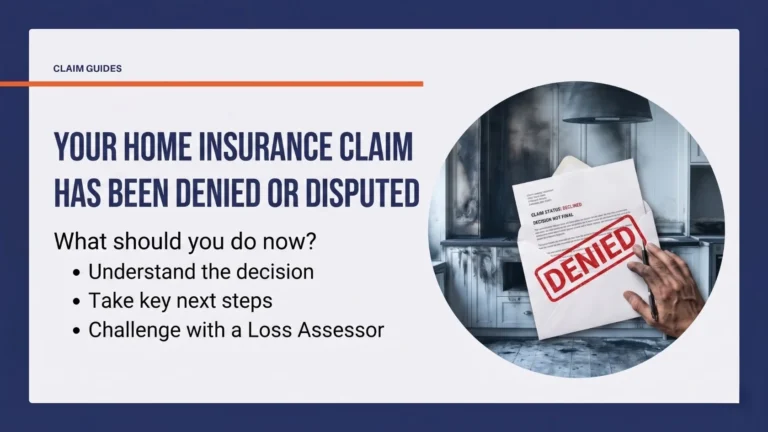
Your home insurance claim has been denied or disputed. What should you do now?
If your insurer has refused your claim, disputed part of it, or offered less than the damage will cost to repair, the decision does not always have to be final.
A denied or disputed home insurance claim can be difficult to deal with, especially when your property is still damaged and you are unsure what the insurer’s decision really means. You may be worried about repair costs, temporary disruption, or accepting an offer that does not put your home back to its previous condition.
The first step is to understand exactly why the insurer has reached its decision.
In many cases, claims are disputed because evidence is incomplete, the damage has been under-scoped, or the insurer has taken a narrow view of what the policy covers. You have options. You can ask the insurer to review the decision, make a formal complaint, refer the matter to the Financial Ombudsman Service where appropriate, or appoint your own independent loss assessor to review the claim.
This guide explains what a denied, repudiated, disputed, or underpaid home insurance claim means, what routes are available, and how PCLA can help you challenge an outcome that does not reflect the true damage.
Denied, repudiated, disputed, and underpaid claims: what is the difference?
When an insurer refuses or limits a claim, the wording matters. Different decisions require different responses.
Denied claim
A denied claim means the insurer has refused to pay part or all of the claim.
This may happen because:
- the cause of damage is not covered by the policy;
- of common home insurance exclusions written into the policy, which is why it’s worth checking your cover before you claim;
- the damage is due to wear and tear, gradual deterioration, or lack of maintenance;
- policy conditions were not met;
- there is not enough evidence to support the claim.
A denial does not automatically mean the insurer is correct. The decision should be reviewed against the policy wording, the cause of damage, and the evidence available.
Repudiated claim
Repudiation is more serious.
A repudiated claim usually means the insurer is treating the policy as if it should not respond to the loss. This may happen where the insurer alleges non-disclosure or misrepresentation when the policy was arranged.
For example, the insurer may argue that important information was not provided when the policy was taken out or renewed.
If your claim has been repudiated, the insurer’s reasoning should be examined carefully. This type of decision can have significant consequences, so it is important to understand the evidence behind it before accepting the outcome.
Disputed or under-scoped claim
This is one of the most common situations in property damage claims.
The insurer may accept that an insured event has happened, but disagree about:
- the extent of the damage
- which rooms or areas have been affected
- whether concealed damage has been properly investigated
- what reinstatement work is necessary
- the cost of putting the property back to its pre-loss condition
This can lead to an offer that is too low to complete the required repairs.
Many homeowners describe this as a rejected claim, even where the insurer has not refused the claim in full. In practice, the claim has been accepted but under-scoped or underpaid.
All of these situations can be challenged. The right route depends on why the insurer has made its decision. Find out what cash settlement alternatives could be available for you.
Need help now?
Call PCLA now on 028 9581 5318.
We cover Northern Ireland and Scotland and can advise you at no cost before you commit to anything.
Example: a disputed escape of water claim in Craigavon
A homeowner in Craigavon noticed deterioration to low-level wall plaster in the hallway. A leak detection specialist was instructed and identified the cause as a leaking hot water pipe embedded within the property’s concrete floor slab.
Although there was clear evidence of water damage, the insurer disputed the extent of the claim. The position taken was that much of the damage was either unrelated to the leak or did not require the level of reinstatement being claimed.
PCLA was appointed to review the damage independently and manage the claim on behalf of the policyholder.
Following a detailed assessment, moisture investigations, and the preparation of a comprehensive schedule of works, PCLA demonstrated that the leak had caused wider damage throughout the property. This included damage to floor coverings, wall plaster, wall tiles, decorations, and other affected areas.
The full extent of the damage was recognised and the claim settled for £32,817.50, allowing the property to be properly restored.
This is a common issue in escape of water claims. The initial insurer assessment may limit the scope. An independent, evidence-led review can help show what has actually been damaged and what reinstatement is reasonably required.
Why home insurance claims are denied or disputed
Insurers can dispute claims for several reasons. Some decisions are valid. Others are based on incomplete evidence, narrow interpretation, or an initial assessment that does not fully reflect the damage.
Common reasons include the following.
Policy exclusions
The insurer may argue that the damage is excluded under the policy.
Common examples include wear and tear, gradual deterioration, defective workmanship, lack of maintenance, or damage caused by something outside the insured perils listed in the policy.
Exclusions should not be accepted at face value without understanding how they have been applied. Whether an exclusion is relevant depends on the policy wording, the cause of damage, and the evidence.
Causation disputes
The insurer may accept that damage exists but dispute what caused it.
In an escape of water claim, for example, the insurer may argue that some damage existed before the leak, or that certain areas were affected by condensation, damp, or another cause.
This is where technical evidence matters. Moisture mapping, leak detection reports, photographs, contractor findings, and a clear schedule of works can help establish what damage is connected to the insured event.
Scope limitation
The insurer may accept the claim but limit the repair scope.
This can happen where the initial inspection does not identify all affected areas, where concealed damage has not been investigated, or where reinstatement costs have been underestimated.
The result is often a settlement offer that does not cover the full cost of returning the property to its pre-loss condition.
Underinsurance or betterment
The insurer may reduce the settlement if it believes the property is underinsured or if the proposed works would leave the policyholder in a better position than before the loss.
These are technical areas and should be reviewed carefully. A deduction may be reasonable in some cases, but it must be properly justified.
Non-disclosure or misrepresentation
The insurer may argue that relevant information was not provided when the policy was taken out or renewed.
This can range from a minor administrative issue to a serious dispute about whether the policy should respond at all. The strength of the insurer’s position depends on what was asked, what was disclosed, and how the policy was arranged.
For a broader explanation, see our guide: Why Insurers Reduce or Reject Property Claims.
What to do if your home insurance claim is denied or disputed
Do not rush to accept the insurer’s decision if you believe it is wrong or incomplete.
Start by gathering the key information:
- the insurer’s written decision
- the relevant policy wording
- photographs and videos of the damage
- any leak detection, surveyor, or contractor reports
- estimates or schedules of repair work
- correspondence with the insurer or loss adjuster
- notes of inspections, calls, and dates
Then consider the route that fits your situation.
Option 1: Ask the insurer to review the decision
You can ask your insurer to review its decision if you believe the claim has been wrongly denied, under-scoped, or underpaid.
Your response should be clear and evidence-based. Explain what you disagree with, why you believe the decision is wrong, and what evidence supports your position.
Avoid long emotional explanations. Focus on the facts:
- what happened
- what damage was caused
- what the insurer has accepted or disputed
- what evidence has been overlooked or misinterpreted
- what outcome you are asking the insurer to reconsider
Keep records of all communication.
Option 2: Use the insurer’s formal complaints process
If the issue is not resolved, you can submit a formal complaint to the insurer.
Every insurer must have a complaints process. Your complaint should set out why you disagree with the decision and include any supporting evidence. Ask for a written response.
This route is often required before you can refer the matter to the Financial Ombudsman Service.
Once your complaint is acknowledged, the insurer must investigate it and issue a response. Keep the final response letter safe, as it is important if you later take the matter to the Financial Ombudsman Service.
Option 3: Refer the matter to the Financial Ombudsman Service
If the insurer does not resolve your complaint, or you receive a final response you disagree with, you may be able to refer the matter to the Financial Ombudsman Service.
The Financial Ombudsman Service is a free, independent service that reviews disputes between consumers and financial services firms, including insurers.
It can consider whether the insurer acted fairly and reasonably. In some cases, it can direct the insurer to pay a claim or take other steps to put things right.
The Financial Ombudsman Service may be particularly relevant where the dispute concerns:
- policy wording
- exclusions
- non-disclosure
- misrepresentation
- whether the insurer’s decision was fair and reasonable
It may be less effective where the main disagreement is technical, such as the cost of reinstatement works or the full scope of property damage. In those cases, independent evidence is often essential.
You generally have six months from the insurer’s final response letter to refer your complaint to the Financial Ombudsman Service.
Option 4: Appoint an independent loss assessor
A loss assessor acts for the policyholder, not the insurer.
If your home insurance claim has been denied, disputed, or underpaid, a loss assessor can review the insurer’s position and help present the claim properly.
This can include:
- inspecting the property
- reviewing the insurer’s decision
- assessing the full extent of the damage
- arranging or reviewing technical evidence
- preparing a detailed schedule of works
- identifying gaps in the insurer’s assessment
- managing communication with the insurer and its loss adjuster
- negotiating the claim on your behalf
This route is often most useful where the dispute is about evidence, damage, reinstatement scope, or the adequacy of the settlement offer.
A loss assessor can also support a formal complaint or Financial Ombudsman Service referral where appropriate.
How PCLA helps with denied, disputed, and underpaid claims
PCLA is an independent loss assessor and claims management firm. We act for policyholders, not insurers.
When we are appointed to a denied or disputed claim, we start with the evidence. We do not simply accept the insurer’s assessment or the original repair scope.
1. We assess the damage independently
We inspect the property and review the damage in context.
Where needed, we work with specialist contractors, leak detection engineers, surveyors, or other technical professionals to understand what has happened and what has been affected.
The aim is to establish the true extent of the damage, including areas that may have been missed during the insurer’s initial inspection.
2. We prepare evidence to support the claim
A disputed claim often turns on the quality of the evidence.
PCLA prepares a clear, properly documented claim presentation. This can include photographs, moisture readings, technical findings, contractor input, and a detailed schedule of works.
The schedule sets out what reinstatement is required and why.
3. We manage communication and negotiation
We deal with the insurer and their appointed representatives on your behalf.
This reduces the pressure on you and helps keep the claim focused on evidence, policy cover, and the works required to restore the property.
Where the insurer’s original position was based on incomplete information, a properly evidenced claim can lead to a different outcome.
No Win No Fee support
PCLA operates on a No Win No Fee basis for loss assessing services.
Our fee is a percentage of the settlement amount. If we do not improve your claim outcome, there is no fee for our loss assessing work.
This means you can ask PCLA to review a denied or disputed claim without paying an upfront fee for our loss assessing service.
We will explain the position clearly before you decide whether to proceed.
When should you challenge a denied or disputed claim?
You should consider challenging the decision if:
- the insurer has not explained the decision clearly
- the settlement offer does not cover the repair work required
- the insurer has excluded damage that appears connected to the insured event
- concealed damage has not been investigated
- the insurer has relied on a limited inspection
- contractor estimates are higher than the insurer’s offer
- the insurer has applied an exclusion you do not understand
- you feel pressured to accept a settlement before the damage is fully assessed
You do not need to know whether the insurer is wrong before seeking advice. The purpose of an independent review is to clarify whether the claim has been assessed properly.
Frequently Asked Questions
How long do I have to appeal a denied home insurance claim?
There is no single fixed deadline for asking your insurer to review a denied claim, but you should act promptly. Delays can make evidence harder to gather and may create issues under the policy.
If you want to refer the matter to the Financial Ombudsman Service, you generally have six months from the insurer’s final response letter.
What does repudiation mean in home insurance?
Repudiation usually means the insurer is refusing the claim on more serious grounds, often because it alleges non-disclosure or misrepresentation.
This can affect whether the policy responds at all. If your claim has been repudiated, the insurer’s reasons and evidence should be reviewed carefully before you accept the decision.
Can a denied insurance claim be reopened?
Yes, in many cases.
A denied claim may be reopened if new evidence is provided, if the insurer has misunderstood the cause of damage, or if an exclusion has been applied incorrectly.
The route may involve an insurer review, a formal complaint, the Financial Ombudsman Service, or an independent claim assessment.
What does the Financial Ombudsman Service do?
The Financial Ombudsman Service reviews complaints between consumers and financial services firms, including insurers.
It considers whether the insurer acted fairly and reasonably. If it finds that the insurer’s decision was unfair, it can direct the insurer to take action.
It is often useful in disputes about policy wording, exclusions, non-disclosure, and how the insurer handled the claim.
Do I need a solicitor for a denied home insurance claim?
Not always.
Many denied or disputed property claims can be reviewed through the insurer’s complaints process, the Financial Ombudsman Service, or with support from an independent loss assessor.
A solicitor may be appropriate where there are serious allegations, complex repudiation issues, potential fraud concerns, or where other routes have been exhausted.
What is betterment?
Betterment is where repair or replacement work would leave you in a better position than before the damage happened.
For example, an insurer may argue that replacing old materials with new ones improves the property. In some cases, an insurer may seek to apply a deduction.
Whether that deduction is reasonable depends on the circumstances, the policy, and the reinstatement required.
Can PCLA help if only part of my claim has been disputed?
Yes.
Partial disputes are common. Your insurer may accept part of the claim but reject other rooms, materials, works, or costs.
PCLA can review the full scope of damage and help establish whether the disputed elements should be included.
Can PCLA help if the insurer’s offer is too low?
Yes.
If the settlement offer does not reflect the full cost of reinstatement, PCLA can review the offer, inspect the damage, prepare evidence, and negotiate with the insurer on your behalf.
The aim is to ensure the claim is properly assessed and presented.
Speak to PCLA about your denied or disputed claim
If your home insurance claim has been denied, disputed, or settled for less than the damage warrants, PCLA can review the position and explain your options.
We act for policyholders, not insurers. Our role is to assess the damage, prepare the evidence, and manage the claim in your interests.
Northern Ireland: 028 9581 5318
Scotland: 0141 461 2406
You can also use the contact form on our website.
There is no obligation and no upfront fee for our loss assessing service.
Before accepting an outcome you are not satisfied with, ask for an independent review.
Related Guides
- Loss Assessor vs Loss Adjuster vs Broker: Who Does What?
- Fire Damage Claim: Our Loss Assessor Service
- Downpatrick Fire and Water Damage: Case Study
- Underinsurance and the Average Clause: Why Settlements Get Reduced
- What Are the Most Common Causes of House Fires?
- How a Small Kitchen Fire Can Lead to a Major Claim