Claim Guide · Storm Damage
A storm has just hit your property. You need to know what to do right now, what your policy actually covers, and how to make sure your claim reflects the true cost of putting things right.
This guide covers everything from the first hour after a storm through to final settlement, written for homeowners and landlords in Northern Ireland and Scotland. It also covers a few things most storm damage guides leave out: how insurers and the Financial Ombudsman actually decide disputed storm claims, how underinsurance can quietly reduce a payout even when the storm damage itself is accepted, and how storm damage to a shared roof works in a Scottish tenement.
What this guide helps you do
- Take the right steps in the first hour after storm damage, including safety, evidence and temporary repairs
- Understand what storm damage your buildings insurance policy should cover, especially roof damage and water ingress
- Check how insurers and the Financial Ombudsman decide whether a storm caused the damage
- Recognise underinsurance risks, average clauses and common reasons storm claims are reduced or disputed
- Understand how shared storm-damaged roofs are usually handled in Scottish tenement buildings
Do This First: Emergency Steps After Storm Damage
Before you call your insurer, before you read your policy, do this.
- Make the building safe. Do not climb onto a damaged roof. Do not enter a room with a structural failure overhead. If there are downed power lines or exposed wiring, keep clear and call emergency services. Safety comes first.
- Document the damage before you touch anything. Take photographs and video of every area of damage: the roof, ceilings, walls, floors, and any damaged contents. Do this from multiple angles. Date and time-stamp everything. This evidence underpins your claim.
- Make emergency temporary repairs to prevent further damage. You are entitled to make temporary repairs immediately. Cover exposed roof sections with a waterproof tarp. Board up broken windows. Clear blocked gutters if safe to do so. Keep every receipt for materials and labour, as these costs are usually recoverable under your policy.
- Register the claim with your insurer promptly. Most policies require you to notify your insurer as soon as reasonably possible after the damage occurs. Delay can complicate an otherwise straightforward claim. Call their claims line and get a reference number.
- Think carefully before agreeing a final scope or settlement figure. Your insurer will send a loss adjuster to inspect the damage and value the claim on the insurer’s behalf. That does not mean the first figure they propose is the final word, particularly where hidden damage, soaked insulation, damaged roof timbers or underinsurance has not yet come to light.
Need help now? PCLA covers Northern Ireland and Scotland and can talk through your options before you commit to anything.
No Win, No Fee. No upfront cost. No obligation to call.
Key facts about storm damage claims
- Roof damage caused by a qualifying storm is normally covered under a standard UK buildings insurance policy.
- You can make reasonable temporary repairs straight away to prevent further damage, but you should photograph everything first and keep receipts.
- A 55mph wind reading is not the only factor in a disputed storm claim. The wider evidence and the pattern of damage matter too.
- Underinsurance can reduce the payout even where the insurer accepts the storm caused the damage.
- In Scottish tenements, storm damage to the roof is usually a shared responsibility across owners, not only the top-floor flat.
Start here
Does Home Insurance Cover Storm Damage to the Roof?
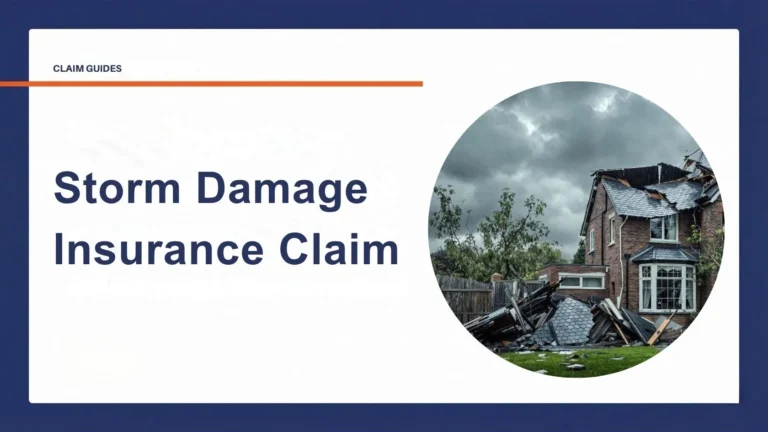
Yes. Roof damage caused by a qualifying storm is covered under a standard buildings insurance policy in the UK. This includes missing or lifted tiles, damaged slates, structural damage to the roof frame, and water ingress that follows storm damage to the roof.
That said, your insurer’s definition of what constitutes a storm is precise, and policies contain exclusions that catch many claimants off guard. Storm claims are also under closer scrutiny than they used to be: insurers paid out £244 million in UK storm damage claims in 2025, a 32% increase on the year before, with the average storm damage payout rising to £2,450 (ABI, February 2026). The sections below explain how insurers apply their storm definition, and what tends to go wrong.
What Counts as a Storm? How Insurers and the Ombudsman Actually Decide
Most guides to storm claims stop at “55mph winds.” That is only part of the picture, and treating it as the whole test can cost you a valid claim.
The industry standard definition is a period of violent weather involving one or more of:
- Wind gusts of at least 55mph, Force 10 on the Beaufort Scale
- Torrential rainfall of at least 25mm per hour
- Snow to a depth of at least 30cm, or one foot, in 24 hours
- Hail intense enough to damage hard surfaces or break glass
If any of these were recorded in your area on the date of the damage, you meet the industry’s baseline definition of a storm.
Where it gets more useful: when a storm claim is disputed and referred to the Financial Ombudsman Service, the Ombudsman does not simply check whether local wind speed hit 55mph. It applies a three-question test:
- Did storm conditions occur on or around the date the damage happened?
- Is the damage consistent with what is generally seen as storm damage?
- Were storm conditions the main cause of the damage, or would the damage likely have happened anyway?
This matters in practice. In one published Financial Ombudsman Service case study, an insurer refused a roof claim on the basis that recorded wind speeds had not reached Force 10 on the Beaufort Scale. The Ombudsman disagreed with treating that single reading as decisive, looked instead at wider local weather station reports and reports of significant wind and rain across the claimant’s postcode that day, and considered the pattern of damage and the insurer’s own surveyor comments. It concluded wind was the likely cause of the tiles coming off the roof, and told the insurer to deal with the claim as storm damage.
What this means for your claim: a single distant weather station reading below 55mph is not automatically the end of the matter, if the wider evidence, nearby stations, damage pattern, condition of the property and neighbouring damage support a storm event. This is exactly the kind of evidence an independent assessment can help pull together.
Separately, consumer research by Which? reviewing 133 UK home insurance policies found that around 20% contained a storm definition it judged potentially unfair, with over half of those covering only wind-related damage and excluding rain, hail or snow events that most people would reasonably expect to be covered. It is worth checking your own policy wording rather than assuming every insurer applies the same test.
What storm damage is usually covered
- Missing, lifted or broken roof tiles and slates
- Structural roof damage caused by high winds
- Water ingress through a storm-damaged roof, wall or window
- Tree impact where the building itself is damaged
- Flying debris impact and reasonable alternative accommodation where the home is uninhabitable
What is commonly not covered
- Fences, gates, hedges and garden walls under many standard policies
- Detached sheds, greenhouses and outbuildings where excluded or limited
- Pre-existing damage, poor maintenance and gradual deterioration
- Saltwater corrosion or storm surge damage under standard buildings policies
- Tree removal where the fallen tree has not damaged the structure
What Storm Damage Is Covered Under a Buildings Insurance Policy
A standard buildings insurance policy in Northern Ireland and Scotland should cover the following storm-related damage:
Roof damage
Missing, lifted, or broken roof tiles and slates. Structural damage to roof timbers caused by high winds. Emergency temporary repair costs, such as tarpaulin, boarding and scaffolding access for immediate works.
Water ingress through a storm-damaged structure
If a storm breaches your roof, walls, or windows and rainwater enters the property as a result, the subsequent water damage to ceilings, floors, walls, and fixtures is covered. This is an important distinction: the water damage is covered because the storm caused the point of entry.
Fallen trees and debris
If a tree falls onto your property during a storm, the cost of removing it from the building and repairing the damage is covered. Removal costs for a tree that falls without damaging the structure are generally not covered.
Debris impact
Damage caused by flying debris, such as roof slates from neighbouring properties, broken fencing panels or garden furniture, is treated as storm damage if it can be shown the impact occurred during the storm event.
Alternative accommodation
If the storm renders your home uninhabitable, your insurer should cover reasonable alternative accommodation costs while repairs are carried out. Keep all receipts.
What Is Not Covered
Policies contain exclusions that surprise many claimants. These are the most common:
Fences, gates, and garden walls
Most standard policies explicitly exclude fences, gates, hedges, and garden walls from storm damage cover. Even where the storm is the direct cause, these costs are generally not recoverable under a standard buildings policy.
Detached outbuildings and garden structures
Sheds, greenhouses, detached garages, and similar structures are frequently excluded or subject to separate, lower limits. Check your policy schedule carefully.
Pre-existing damage and poor maintenance
This is the most commonly used reason for reducing or rejecting a storm claim. If your roof had cracked or missing tiles, deteriorated mortar, or known structural issues before the storm, the insurer may argue the storm did not cause the damage, the existing condition did. Maintenance records and any pre-storm inspection reports can significantly strengthen your position. It is worth noting that a roof showing some age-related wear does not rule out a storm claim: the relevant question is whether the storm was the main cause of the actual failure, not whether the roof was in perfect condition beforehand.
Gradual deterioration
Damage that has developed over time, rather than resulting suddenly from a storm event, is not covered.
Coastal corrosion and storm surge
Standard policies generally do not cover saltwater corrosion damage or damage caused by storm surge to coastal properties. Flood risk cover is a separate policy addition.
Underinsurance: The Storm Claim Risk Most Guides Don’t Mention
Even where a storm claim itself is accepted without dispute, the settlement figure can still come in lower than expected for a different reason entirely: underinsurance.
How it works. Most buildings policies include an “average clause.” If your declared sum insured is less than the true rebuild cost of your property, the insurer is entitled to reduce any payout by the same proportion, even for a partial loss like a storm-damaged roof. For example, if your home is insured for only two-thirds of its actual rebuild cost, a valid £30,000 roof reinstatement claim could be reduced to around £20,000 before any excess, purely because of the average clause, with the storm cause of the damage never in dispute.
Why this is a live issue. A 2022 survey of 4,800 UK properties by a leading valuations firm found that 75% were underinsured, by an average of 53%. Rebuild-cost inflation, including labour and materials costs, since 2021 has made this worse for many homeowners who last reviewed their sum insured some years ago. A storm claim, particularly one involving roof or structural reinstatement, is often the first time a property’s sum insured actually gets tested.
Why it is not necessarily the end of the story. The Financial Ombudsman’s own guidance on underinsurance complaints looks at whether the insurer clearly asked the customer to confirm the rebuild cost, gave clear guidance on how to calculate it, and clearly explained the consequences of getting it wrong. Where that did not happen, it is not always fair for the insurer to apply the average clause in full. This is worth checking rather than accepting a reduced settlement figure at face value.
Storm-specific point: because storm damage often triggers the first proper rebuild-cost assessment a property has had in years, it is common for underinsurance to surface at exactly the point a homeowner can least afford a reduced payout. Checking whether average has been applied correctly, and whether it was applied fairly, is part of reviewing any storm settlement offer.
Emergency Repairs After a Storm: What You Can and Cannot Do
You do not have to wait for the loss adjuster before making emergency repairs. You have a duty to mitigate further damage, meaning you are expected to take reasonable steps to prevent the situation getting worse.
You can:
- Cover exposed roof sections with waterproof sheeting or tarpaulins
- Board up broken windows and doors
- Clear gutters and downpipes of storm debris
- Move salvageable contents away from water-damaged areas
- Arrange emergency plumber or roofer attendance for urgent structural issues
You must:
- Photograph everything before any repair work begins
- Keep all receipts for emergency materials and contractor attendance
- Report to your insurer promptly, as most insurers operate a 24-hour claims line
You should not:
- Carry out permanent repairs before the loss adjuster or a surveyor has assessed the damage
- Discard damaged materials, including tiles, timbers and damaged contents, until the claim has been assessed
- Agree to repair works through a contractor appointed by your insurer without understanding what scope has been approved
If you are unsure what repair actions are safe to take without affecting your claim, call PCLA on 028 9581 5318 before proceeding.
How to Make a Storm Damage Insurance Claim: Step by Step
Step 1: Notify your insurer
Call your insurer’s claims line as soon as the damage is safe to assess. Give them the date and nature of the damage. Get a claim reference number.
Step 2: Gather your evidence
Photograph all damage in detail before anything is moved or repaired. Note down the date, time, and weather conditions. Retrieve any weather warnings issued for your area on the date of the storm, as this is exactly the kind of evidence the Financial Ombudsman gives weight to when a storm’s severity is disputed.
Step 3: Make temporary repairs and keep receipts
Take the emergency steps described above. Record all costs.
Step 4: Your insurer appoints a loss adjuster
The insurer will send a loss adjuster to assess and value the damage. Understanding who a loss adjuster works for, and how that differs from a loss assessor, helps you prepare for this stage.
Step 5: Review the loss adjuster’s report and the insurer’s offer
Check whether the scope of damage in the report reflects what you can see, and whether it accounts for hidden damage such as water-soaked insulation, damaged timbers, or damp-affected plasterwork. Check too whether the settlement figure has been reduced for underinsurance, and if so, on what basis.
Step 6: Agree the settlement and arrange reinstatement
Once the scope and value of the claim are agreed, the insurer will either arrange works through their appointed contractors or settle on a cash basis. You have the right to appoint your own qualified contractor for reinstatement work.
Loss Adjuster or Loss Assessor: Who Does What?
When you make a storm damage claim, your insurer appoints a loss adjuster to investigate and value the claim on the insurer’s behalf. Loss adjusters are experienced professionals, and their assessment is genuinely intended to be fair within the terms of your policy, but their commercial relationship is with the insurer, not with you.
A loss assessor, such as PCLA, is appointed by and works for the policyholder. We inspect the property, prepare the evidence, check the scope of damage and the settlement figure, including whether underinsurance has been applied correctly, and negotiate with the loss adjuster on your behalf.
For a full explanation of the difference, and why it matters for the value of your claim, see our guide: Loss Assessor vs Loss Adjuster vs Broker: Who Does What?
Why Storm Damage Claims Get Rejected, Reduced, or Disputed
The weather evidence is treated as incomplete.
Insurers sometimes rely on a single nearby weather station reading that falls just short of the 55mph threshold. Wider local weather reports, the pattern of damage, and evidence from neighbouring properties can all support a storm claim even where one data point looks marginal.
Pre-existing condition or maintenance is blamed instead of the storm.
If the roof had some age-related wear, the insurer may argue the deterioration, not the storm, caused the failure. The relevant question is whether the storm was still the main cause of the actual damage, not whether the roof was in new condition beforehand.
Delayed reporting.
Reporting the claim days or weeks after the damage gives the insurer grounds to question whether the damage is attributable to the storm event. Report promptly.
Insufficient documentation.
Claims without detailed photographs, a complete schedule of damage, and supporting evidence for costs are easier for an insurer to reduce or contest.
Items outside the policy’s scope.
Claiming for fences, gates, outbuildings, or other excluded items, even inadvertently, can complicate the overall claim.
Underinsurance reduces the payout.
Even an accepted storm claim can be paid at a reduced value if the property is underinsured and the average clause applies.
Hidden damage is missed at the first inspection.
Soaked insulation, damp-damaged timbers, and mould risk in water-affected voids are frequently missed at the initial survey and only found once reinstatement work begins.
This pattern is consistent with what the Financial Ombudsman sees more broadly. The Ombudsman reported that buildings insurance complaints reached a ten-year high in the 2023/24 financial year, driven significantly by complex and costly storm and flood damage claims, with 41% of buildings insurance complaints upheld in the consumer’s favour. That is not a reason to assume every claim is being handled unfairly, but it does mean a second look at a disputed or reduced storm settlement is often worthwhile.
Storm Damage Claims in Northern Ireland and Scotland: Regional Context
Northern Ireland
Northern Ireland experiences frequent Atlantic storm systems, particularly between October and March. The 2023/24 storm season brought 12 named storms across the UK and Ireland, the most since the Met Office’s naming system began in 2015, including Storms Isha and Jocelyn in quick succession in January 2024. Storm Isha alone brought gusts of around 99mph and left Northern Ireland the worst-affected part of the UK for power cuts, with more than 45,000 homes affected. Storms on this scale generate large volumes of roof, chimney, and structural claims across the region.
A Coleraine storm tree strike, settled at £34,517.88
A family living in a three-bedroom detached property in Coleraine suffered extensive damage after severe storm conditions brought down a mature beech tree onto their home. The tree struck the roof before collapsing across part of the rear elevation, damaging the building and several external structures. Emergency contractors were required to remove the tree before the property could be fully inspected.
The damage extended to the roof structure and coverings, roof timbers, loft insulation, a rear bedroom ceiling, two first-floor windows, the conservatory roof, garden fencing, a timber shed, the patio, and rainwater goods and guttering. Once the tree had been removed, further inspection uncovered hidden structural damage to the roof framework and water ingress affecting internal ceilings and decorations. Establishing the full extent of the damage required input from structural engineers and roofing specialists, alongside a detailed schedule of reinstatement works.
The claim was settled for £34,517.88.
“The damage was far worse than we first thought. Every inspection seemed to uncover something else. PCLA managed the whole process, dealt directly with the insurer and made sure all of the hidden damage was included in the claim. We could simply focus on getting our family back into the house.”
Storm damage from fallen trees frequently extends well beyond what is visible immediately after the event. Thorough inspection and a detailed schedule of works are often what stand between an initial estimate and a settlement that reflects the true cost of reinstatement.
A Banbridge storm damage claim, settled at £3,900
A homeowner in Banbridge suffered storm damage to their roof following Storm Amy, which also caused internal damage to the living room. PCLA attended the property within days to inspect the damage, then met with the insurer the following week to help progress the claim. The claim was settled for £3,900.
“Declan from PCLA was brilliant throughout. We had an issue with storm damage, he came within a number of days to inspect and then the following week with the insurer. Within 24hrs we had a settlement! Great communication and really easy to work with. Appreciate all Declan done for us!”
Case details shared with the permission of the policyholders.
Scotland
Scotland’s exposure to severe winter storms is among the highest in the UK, with the Central Belt, west coast, and northern regions particularly affected by named storm events. Properties across Glasgow, Edinburgh, and the wider Central Belt are frequently subject to roof tile loss, structural wind damage, and water ingress. PCLA operates across the Scottish Central Belt and handles storm claims for both residential and commercial properties.
Storm damage to a shared roof in a Scottish tenement
If you live in a tenement flat in Glasgow, Edinburgh, or elsewhere in Scotland, a storm-damaged roof is rarely a single-owner problem. Under the Tenements (Scotland) Act 2004, the roof of a tenement building is generally treated as “scheme property,” meaning it is common property shared between the flat owners, whatever an individual title deed happens to say about who has access to it.
Where title deeds are silent on responsibility, the Act’s default Tenement Management Scheme applies: the roof and other structural common parts are maintained at the shared cost of all the owners, usually split equally, unless one flat is more than 1.5 times the floor area of the smallest, in which case costs can be split by floor area instead.
For a storm-damaged tenement roof, this generally means:
- The cost of storm repairs to the roof is a shared responsibility across the building’s owners, not just the top-floor flat.
- Insurance claims may need to be coordinated across multiple owners, or made under a shared block buildings policy where one is in place.
- Individual owners cannot usually be forced to fund roof repairs alone simply because they happen to be on the top floor.
An independent assessor can help coordinate evidence and communication across several owners on a shared storm claim, which is often the main practical difficulty in these cases rather than the insurance cover itself.
How PCLA Handles Storm Damage Claims
PCLA is an independent loss assessing firm. We work for policyholders, not insurers. Our team includes qualified building surveyors and experienced claims practitioners with detailed knowledge of the NI and Scottish insurance markets.
When you appoint PCLA to manage your storm damage claim, we:
- Inspect your property and prepare a full schedule of all storm-related damage, including hidden damage that may not be visible at first inspection
- Check whether the weather evidence available supports your claim, drawing on wider local records where a single reading looks marginal
- Review your policy wording in full, including how any underinsurance or average clause has been applied
- Prepare and present the claim to your insurer in a clear, well-evidenced format
- Liaise directly with the loss adjuster on your behalf
- Negotiate the settlement so it reflects the true cost of reinstatement
- Coordinate the claim through to final payment
We work on a No Win, No Fee basis. There is no upfront cost, and nothing to pay if we do not recover a settlement for you.
What Happens If My Storm Claim Is Disputed or Reduced?
If your insurer disputes the claim, whether by rejecting it outright, attributing the damage to wear and tear, applying an average clause you are not sure is fair, or offering a settlement that does not reflect your losses, you have options.
Start by requesting a full written explanation of the insurer’s position. An independent assessment of the damage, and of how the settlement figure has been calculated, often resolves the majority of disputed storm claims without the need for formal escalation.
If the dispute cannot be resolved directly, you have the right to refer your complaint to the Financial Ombudsman Service, a free, independent complaints service. You normally have eight weeks from the insurer’s final response before you can refer a complaint.
If you are thinking about making a storm damage claim, or you have received a settlement offer you are not sure reflects the true cost of the damage, PCLA can review your position before you commit to anything further with your insurer.
Frequently Asked Questions
Does home insurance cover storm damage to the roof in Northern Ireland?
Yes, if the damage was caused by a qualifying storm event. Your buildings insurance policy should cover sudden structural damage to the roof, including missing tiles, lifted slates, and damage to the roof frame, and any water ingress that results. Insurers check weather evidence for your area to confirm the event met their storm definition, and the Financial Ombudsman applies a broader three-question test where this is disputed.
How long do I have to make a storm damage insurance claim?
There is no single fixed deadline, but your policy will require you to notify your insurer promptly after the damage occurs. Delaying notification can give the insurer grounds to question the link between the damage and the storm event. Report as soon as it is safe to do so.
Can I make emergency repairs before the loss adjuster visits?
Yes. You have a duty to mitigate further damage. You can cover exposed areas, board up windows, and make temporary repairs immediately. Photograph all damage before you start, keep every receipt, and avoid permanent repairs before the damage has been surveyed.
What if my insurer says the damage is due to wear and tear, not the storm?
This is one of the most common grounds for reducing or rejecting a storm claim. It is worth challenging where the storm was still the main cause of the actual failure, even if the roof had some pre-existing wear. An independent assessment can help establish this.
Why has my storm claim been reduced even though the insurer accepted it was storm damage?
This is often underinsurance. If your buildings sum insured is below the true rebuild cost of your property, the insurer may apply an “average clause” and reduce the payout proportionally, even for a partial loss. It is worth checking how this has been calculated and whether it was applied fairly.
Are fences and gates covered under storm damage insurance?
No. In most standard buildings policies, fences, gates, hedges, and garden walls are explicitly excluded from storm damage cover, even where the storm was the direct cause.
Who does the loss adjuster work for?
The loss adjuster works for your insurer, or is contracted to them, and assesses the claim within the terms of your policy. A loss assessor works for you. See our full guide: Loss Assessor vs Loss Adjuster vs Broker.
Who is responsible for storm damage to the roof of a shared tenement building in Scotland?
Under the Tenements (Scotland) Act 2004, the roof is generally treated as common property shared by all the flat owners in the building, regardless of which flat has direct access to it. Repair costs are usually shared, most often equally, unless one flat’s floor area is significantly larger than the others.
Does home insurance cover storm damage to outbuildings and sheds?
Not usually under a standard policy. Detached outbuildings, sheds, and greenhouses are frequently excluded or subject to low separate limits. Check your policy schedule for the specific terms.
My storm damage claim was rejected or reduced. What can I do?
Request a full written explanation from your insurer. An independent assessment of the damage, and of how any settlement figure was calculated, can identify whether the rejection or reduction is well founded. If you are considering a claim, or have already received an offer you are unsure about, PCLA can talk through your options before you take it further.
Get Help With Your Storm Damage Claim
PCLA operates across Northern Ireland and Scotland. We are qualified building surveyors and experienced claims practitioners, authorised and regulated by the Financial Conduct Authority (FRN 933781).
If you have storm damage to your property and want to know where you stand before you claim, or before you settle, call us.
[email protected]
No Win, No Fee. No upfront cost. No obligation to call.