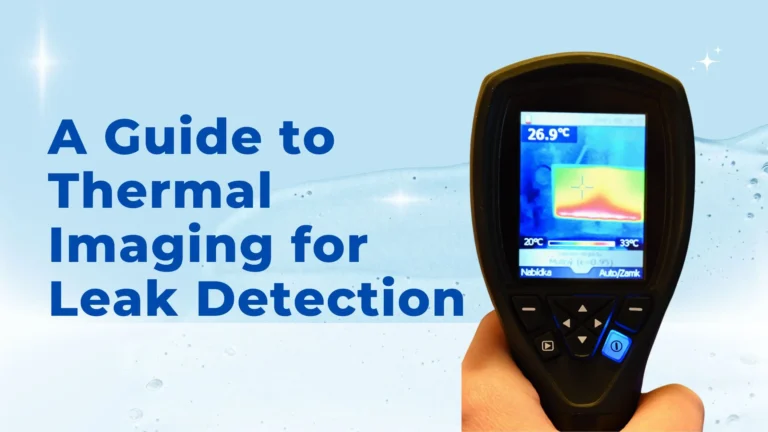
Yes, a thermal imaging camera can detect water leaks, but not by seeing water. It reads surface temperature, so what it actually shows is a temperature anomaly: the cool patch left by evaporating moisture, or the warm plume of a hot water pipe leaking under a floor. Used properly, a thermal survey narrows a leak down to a small area without opening up floors or walls. This guide covers how thermal imaging leak detection works, what a thermal camera can and cannot see, what to look for in one, and where it needs a second method to confirm.
Key Takeaways
- Thermal imaging is a non-invasive way to locate hidden leaks and moisture, and it is at its strongest on hot water and heating pipes.
- A thermal camera detects temperature difference, not water. It cannot see through a wall or a floor slab.
- Findings are confirmed with a moisture meter, and often with acoustic or tracer gas testing, before anything is opened up.
- The thermal images are also evidence, which matters when the cost of finding the leak goes to an insurer.
What Is Thermal Imaging Leak Detection?
Thermal imaging, also called infrared thermography, uses an infrared camera to measure the heat radiating from a surface and translate it into a visible image. Warmer areas render in reds and oranges, cooler areas in blues and greens. In a leak detection context, the camera is scanned across floors, walls and ceilings looking for a heat pattern that does not belong. Thermography of this kind is used across building inspection work generally, and water leak detection is one application of it.

Two different signatures point to a leak. A hot water or central heating pipe leaking under a screed warms the surface above it, showing as a bright plume that spreads out from the pipe run. A cold water leak works the other way: the moisture it leaves behind evaporates, evaporation cools the surface, and the wet area shows up colder than the dry material around it. That second effect is why thermal imaging is still useful on cold pipes, even though it is less reliable there.
What a Thermal Camera Can and Cannot See
This is the single most misunderstood point about thermal imaging, and it is worth being blunt about. An infrared camera does not see through anything. It measures the temperature of the outermost surface it is pointed at. A leak inside a wall is detectable only because it has changed the temperature of the plaster you can see. If the leak has not yet reached the surface, or the surface has been warmed by sunlight or a radiator, there may be nothing to find.
What this means in practice:
- A temperature differential has to exist. A leak that has soaked an area to the same temperature as its surroundings is invisible to the camera. Running the heating before a survey deliberately creates the differential.
- Thick or insulating materials mask the signal. A deep concrete slab, thick insulation or a suspended timber floor with an air gap all slow the heat reaching the surface.
- Weather conditions matter. Direct sun on an external wall, or a room that has just been heated, can swamp the anomaly you are looking for.
- A thermal anomaly is not proof of water. It is a lead. Confirming it is a separate step.
How a Thermal Imaging Survey Works
- Preparation: the system is brought up to pressure and, where the suspicion is a hot pipe or heating circuit, run so the leak has a temperature to give away. Furniture and floor coverings are moved off the suspect area.
- Scanning: the technician sweeps the infrared camera across the floor, wall or ceiling, working in overlapping passes so no section of the surface is missed.
- Identifying anomalies: heat patterns are read against what the building should look like. A warm line following a known pipe run is expected; a warm blob spreading away from it is not.
- Verification: a moisture meter is used on the suspect area to confirm water is actually present, and acoustic or tracer gas testing is brought in where the picture is ambiguous.
- Marking and reporting: the location is marked for the repair, and the thermal images are recorded as part of the detection report.
Equipment Used in a Thermal Imaging Inspection
1. Infrared Camera
The primary tool. Handheld thermal imaging cameras used for building inspection work capture infrared radiation and convert it into a temperature image. Professional models such as the FLIR E8-Pro and the Testo 872 are common in UK plumbing and thermographic survey work.
2. Moisture Meter
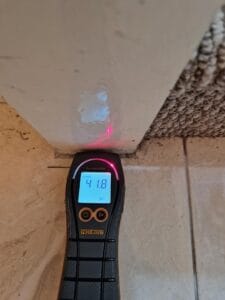
A moisture meter is what turns a thermal anomaly into a finding. Pin meters read conductivity between two probes; capacitance meters read moisture through the surface without marking it, which is the usual choice on a finished wall or floor. The camera says where to look, the meter says whether it is wet.
3. Surface Temperature Thermometer
A spot thermometer is used to check the camera’s reading against a direct measurement at a specific point, which is a quick sanity check on an ambiguous image.
What to Look for in a Thermal Camera for Leak Detection
If you are comparing thermal imaging devices rather than booking a survey, three specifications decide whether a camera is usable for finding leaks and moisture.
| Specification | Why it matters for leak detection |
|---|---|
| Thermal sensitivity (NETD) | The smallest temperature difference the camera can resolve, quoted in millikelvin. Leak signatures are often a fraction of a degree, so a lower NETD figure is the specification that matters most. |
| Detector resolution | The number of true infrared pixels, not the screen size. Higher resolution means a small anomaly stays visible from a working distance instead of being averaged away. |
| Temperature range and calibration | A camera that holds its calibration gives readings you can compare between visits, which matters when a survey is repeated to see whether an area is drying. |
Be wary of low-cost handheld thermal imagers and phone attachments for this specific job. They will show you a warm radiator, but a small leak signature at the edge of a slab is exactly the case where a weak detector and a coarse resolution produce a confident-looking image with nothing real in it.
Thermal Imaging for Water Leak Detection: Finding Hidden Water in a Building
An infrared inspection is not only for burst pipes. The same thermographic survey will detect moisture from any source of water ingress, which is useful because moisture intrusion often reaches a room a long way from where it started. A specialist scanning for problem areas is reading minute temperature differences across large areas of surface, and that is what makes it possible to map the extent of moisture damage as well as find its origin. These are the situations where it earns its keep.
- Pipes under concrete floors. The classic case, and the reason thermal imaging became standard. Copper embedded in a slab cannot be inspected any other way without breaking it open. There is more on this in our guide to locating leaking copper pipes in concrete floors.
- Underfloor heating. A wet underfloor heating circuit is close to an ideal target, because the whole loop is warm and a breach shows as a distortion in an otherwise regular pattern.
- Ceilings below a bathroom. Water tracking through a ceiling void spreads well beyond the source, and the cool evaporating area maps the extent of it.
- Flat roofs and water infiltration. Wet insulation holds heat differently to dry insulation, so a roof scanned as it cools in the evening reveals saturated sections.
- Air conditioning and HVAC condensate. A blocked condensate drain produces damp that looks like a plumbing leak until the survey shows where it starts.
- Missing insulation and draughts. The same building inspection technique shows cold bridging and air infiltration, which is worth knowing if the complaint is a cold room rather than a leak.
Advantages of Thermal Imaging for Leak Detection
| Advantage | Description |
|---|---|
| Non-invasive | Locates a leak without damaging floors or walls. |
| Precise | Narrows the area to be opened up, so the repair and the making good are both smaller. |
| Fast | Large areas can be scanned quickly, which matters when water is still running. |
| Detects moisture the eye cannot | Picks up damp behind a finished surface before staining appears. |
| Works over many materials | Tile, hardwood, laminate, plaster and concrete all carry a readable surface temperature. |
| Produces evidence | The images document the finding for a repair contractor or an insurer. |
Limitations of Thermal Imaging
| Limitation | Description |
|---|---|
| Strongest on hot water | Cold water leaks are detectable through evaporative cooling, but the signal is weaker and easier to miss. |
| Needs a temperature difference | An anomaly that has equalised with its surroundings will not show. |
| Environmental interference | Sunlight, recent heating and retained heat in a slab all create false patterns. |
| Requires expertise | Interpreting a thermal image is the skill. The camera is the easy part. |
| Not confirmation on its own | A finding is verified with a moisture meter or a second detection method before anyone opens up a floor. |
Common False Positives, and How They Are Ruled Out
Most of what a beginner reads as a leak is not one. Pipe runs in service, warm air from a duct, a radiator that has just gone off, sunlight through a window and cold bridging at a wall junction all produce convincing anomalies. Each is ruled out the same way: check whether the pattern follows building services rather than water movement, take a moisture reading, and re-scan after conditions have changed. An anomaly that persists when the heating has been off for hours and reads wet on a meter is a leak. One that disappears is not.
Thermal Imaging Compared With Other Leak Detection Methods
| Method | Advantages | Disadvantages |
|---|---|---|
| Thermal imaging | Non-invasive, fast, strong on hot water and heating pipes, covers large areas | Weaker on cold water, affected by ambient conditions, surface reading only |
| Acoustic leak detection | Works on hot and cold pipes, pinpoints a pressurised leak by sound | Needs a quiet property, struggles on very low pressure or plastic pipe |
| Tracer gas detection | Highly sensitive, finds leaks the other methods miss | Slower, requires the system to be drained and charged with gas |
| Pressure testing | Confirms whether a leak exists at all, and on which circuit | Gives no location, so it is a first step rather than an answer |
In practice these are combined rather than chosen between. A survey often starts with pressure testing to prove there is a leak, uses thermal imaging to narrow the search, and confirms with acoustic testing or tracer gas before a single tile is lifted.
Residential and Commercial Thermal Imaging Surveys
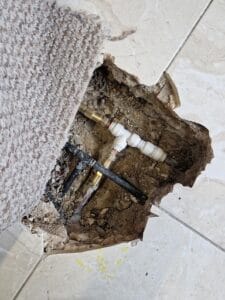
In a house, the value of a thermal survey is almost always the floor that does not get lifted. Leaks behind walls, under screed and above ceilings are the ones that would otherwise be found by trial and error, and the making good after an exploratory search usually costs more than the plumbing repair itself.
In a commercial building the calculation is different. Pipework runs are longer, more of it is concealed above ceilings and in risers, and the real cost of a leak is the disruption to trading while it is chased. Scanning a floor plate in an evening is a far cheaper way to find it than closing an area for exploratory works, which saves time and money against any exploratory approach. The same industrial applications extend to plant rooms and process pipework, where a leak on a heating or chilled circuit shows up clearly against its surroundings.
Think You Might Have a Hidden Leak?
Thermal imaging can often confirm a leak without opening up floors or walls. Contact PCLA’s leak detection service in Northern Ireland to arrange an inspection.
Thermal Imaging on a Live Job, and What It Saves
The value of thermal imaging is measured in floors not lifted. On a Downpatrick job the leak was pinpointed before any floor came up, which is the whole point of a non-invasive survey.
Thermal images also carry weight as evidence. A clear before and after gives an insurer something concrete to price, which is part of why how insurers treat the cost of tracing a leak is worth understanding before the survey rather than after it.
Frequently Asked Questions
Can a thermal imaging camera detect water leaks?
Yes, but indirectly. The camera reads surface temperature, not water. A hot water leak warms the surface above it and a cold water leak cools it through evaporation, and both show as a temperature anomaly. A moisture meter is then used to confirm water is present.
Can thermal imaging see through walls?
No. This is the most common misconception about the technology. An infrared camera measures the temperature of the surface it is pointed at. It detects a leak inside a wall only once that leak has changed the temperature of the plaster on the outside.
How accurate is thermal imaging for leak detection?
In the right conditions it will narrow a leak to a small area rather than a room, which is usually enough to keep the opening-up to a single section of floor. Accuracy drops on cold water pipes, on deep or well insulated construction, and where recent heating or direct sunlight has disturbed surface temperatures. That is why findings are confirmed with a second method.
Can thermal imaging detect air leaks?
Yes. Draughts and air infiltration show clearly as cold streaks around windows, doors and at junctions between building elements, and missing insulation shows as cold patching across a wall or ceiling. It is the same survey technique applied to a different problem.
What if the leak has dried before the survey?
A dried area has equalised with its surroundings and will not show. Where the leak is on a hot water or heating circuit, running the system before the survey recreates the temperature difference. Where it is intermittent, pressure testing establishes that a leak exists and the survey is timed to when the system is in use.
Is a thermal imaging survey covered by home insurance?
The cost of finding a leak is usually dealt with under trace and access cover rather than the main escape of water claim, and the limits vary considerably between policies. The detection report and the thermal images are what support that part of the claim, so it is worth reading the cover before booking the survey.
Detection in Northern Ireland: PCLA, 028 9581 5318, or NI Leak Detection. Detection in Scotland: Leak Detection Stirling. Claims: Northern Ireland 028 9581 5318, Scotland 0141 461 2406. PCLA does not offer no find, no fee: quotes are free and costs are clear upfront.