Your boiler keeps losing pressure. You top it up, the gauge sits back at 1.5 bar, and a week or two later it has dropped again. There is no puddle, no drip and nothing obviously wrong. So where is the water going?
A sealed heating system does not use water. If the pressure keeps falling, water is escaping somewhere, or a component is failing to hold it. This guide explains what boiler pressure should be, the common causes of a boiler losing pressure, how to tell a hidden leak from a faulty part, and when to call a Gas Safe registered engineer.
What is the correct boiler pressure?
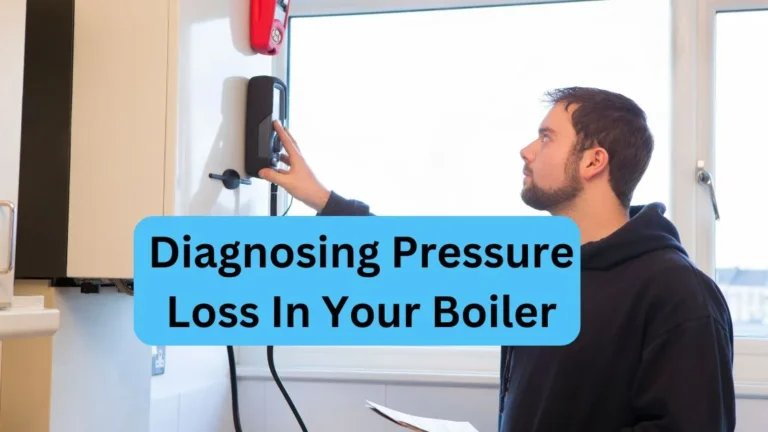
Most modern boilers should sit between 1.0 and 1.5 bar when the system is cold. The needle rises as the heating warms up, often to around 2 bar, and settles back down as it cools. That movement is normal.
Below 1.0 bar the boiler may stop working altogether, because low boiler pressure triggers a lockout on most models. Above roughly 2.5 bar the pressure relief valve will let water out to protect the system. Check the pressure gauge when the system is cold, otherwise you are reading a number that will change.
Why does my boiler keep losing pressure?
There are four common causes, and they behave differently. That difference is how you narrow it down.
| Cause | What you notice | Who fixes it |
|---|---|---|
| A hidden leak in the pipework | Steady, repeated pressure drop with no visible drip. Often worse when the heating is running. Sometimes a warm patch on the floor, a musty smell or lifting flooring. | Leak detection, then a plumber or heating engineer for the repair |
| Faulty pressure relief valve | Water dripping from a small copper pipe outside the property, often near the boiler. Pressure falls slowly and steadily. | Gas Safe registered engineer |
| Failed expansion vessel | Pressure swings widely between hot and cold, climbs high when heating, then drops low. The expansion vessel absorbs pressure changes, and when the diaphragm fails it cannot. | Gas Safe registered engineer |
| Recently bled radiators | A single drop straight after bleeding, then stable once topped up. | Top up once, no further action |
Joints and valves also corrode or loosen with age, particularly at radiator valves, soldered joints and the filling loop. A filling loop left slightly open can let water move the wrong way and cause a pressure problem that looks like a leak.
Can a boiler lose pressure without a visible leak?
Yes, and this is the single most common version of the problem. A sealed central heating system holds a fixed volume of water. If the pressure keeps dropping and no component is at fault, that water is escaping somewhere you cannot see.
Heating pipework runs under floors, inside walls and through concrete slabs. A pinhole in a buried copper pipe can lose enough water to drop the pressure noticeably while evaporating into the floor construction, leaving nothing visible for months. Two things point strongly at a hidden leak rather than a faulty part:
- The pressure falls faster when the heating is on. Hot water expands and the system pressure rises, which pushes more water out through a small breach.
- Nothing is dripping outside. If the pressure relief valve were passing, you would usually find water at the discharge pipe. No discharge, no visible drip, but a steady loss points to a leak somewhere in the pipework.
This is the point at which topping up stops being maintenance and starts being a warning. Our guide to the telltale signs of a central heating leak covers what else to look for.
How do I find a hidden leak in my central heating system?
Not by lifting floors and hoping. A leak inside a slab or under floorboards is located non-invasively first, then exposed only at the confirmed point.
- Thermal imaging reads the heat signature of hot water escaping into the floor construction, which makes heating leaks unusually well suited to it.
- Acoustic tracing picks up the sound of water escaping under pressure through pipework.
- Tracer gas is introduced into the drained system and detected where it surfaces, which works where a pipe is buried too deep for the other methods.
- Moisture mapping confirms how far water has already travelled through the floor or wall.
Where the pipe is buried in a concrete floor, the investigation is more involved and more expensive. Our guide on locating leaking copper pipes in concrete floors explains what that work involves.
How often should you need to top up boiler pressure?
Rarely. Once or twice a year is unremarkable, and a small drop after bleeding radiators is expected. Needing to top up monthly, weekly, or every few days is not normal maintenance and needs investigating.
Topping up repeatedly also does quiet harm. Every top-up introduces fresh oxygenated water into a sealed system, which accelerates internal corrosion. So the habit that feels like managing the problem is shortening the life of the system while the leak carries on.
When should you call a Gas Safe engineer?
Anything inside the boiler casing is Gas Safe work, by law. Call a Gas Safe registered engineer if the boiler is locking out, if you suspect the pressure relief valve or expansion vessel, if you can see water inside or beneath the boiler casing, or if you are unsure how to re-pressurise your model safely.
PCLA are not gas engineers. What we do is find the leak in the pipework when there is no visible fault, and handle the insurance claim when escaping water has damaged the building. Those are different jobs from boiler repair, and it is worth knowing which one you actually need before you pay for either.
When pressure loss turns into damage
Topping up a boiler week after week is not a fix, it is a countdown. The water going missing is going somewhere, usually under a floor or behind a wall, and by the time it shows on the surface the floor construction below has often been wet for months. A pipe failure in Newry ended in a £125,000 settlement once the damage below the surface was assessed properly.
Before you pay to have the leak traced, check what your policy pays towards finding a hidden leak. Most home insurance policies include trace and access cover, which is meant to pay for locating the leak and getting to it. PCLA does not offer no find, no fee. Quotes are free and every cost is set out before work starts.
Frequently asked questions
Is it normal for a boiler to lose 0.1 bar a week?
No. A sealed system should hold its pressure for months. A predictable weekly drop is a slow leak or a failing component, not normal behaviour.
Is it safe to use a boiler with low pressure?
Low pressure is not usually dangerous in itself, and most boilers simply lock out rather than run. The risk is the cause: if water is escaping into the building, the damage continues whether the boiler runs or not.
Can I keep topping up my boiler pressure?
As a short-term measure, yes. As a routine, no. Repeated top-ups introduce oxygenated water that corrodes the system from the inside, and they conceal a leak that is still running.
Can I fix pressure loss with leak sealer?
Sealer added to the system may slow a very small breach, but it does not repair the pipe, and some insurers take a dim view of it where a claim follows. It is worth locating the leak before deciding.
Does boiler pressure drop when the heating is not in use?
A little movement with room temperature is normal. A sustained drop over a summer with the heating off still means water is leaving the system.
How do I know whether I need a plumber or leak detection?
If you can see where the water is coming from, you need a plumber or a Gas Safe engineer. If the pressure keeps dropping and nothing is visible, you need the leak located first.
Detection in Northern Ireland: PCLA, 028 9581 5318, or NI Leak Detection. Detection in Scotland: Leak Detection Stirling. Claims: Northern Ireland 028 9581 5318, Scotland 0141 461 2406.