
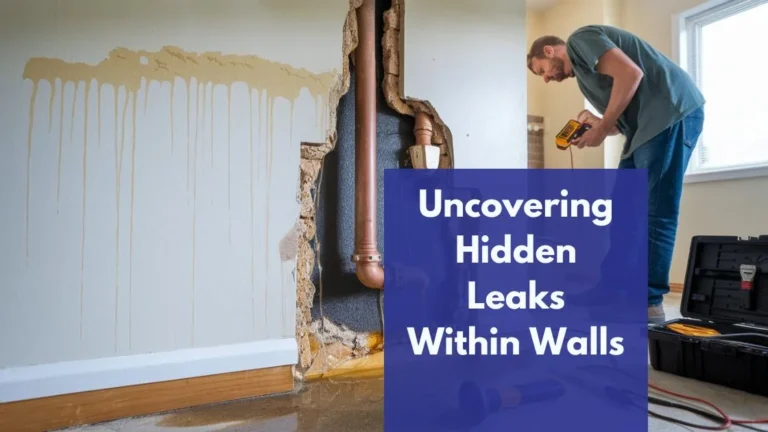
A damp patch has appeared on the wall and nothing obvious explains it. There is no dripping, no burst pipe, and the stain keeps creeping outward. Finding a water leak inside a wall is mostly a process of elimination, and the good news is that the first two checks cost nothing.
Signs of a water leak inside a wall
Most hidden water leaks announce themselves the same way. Look for:
- Water stains on the wall surface, often a dark patch with a defined tidemark that grows over days rather than hours.
- Peeling paint or lifting wallpaper, because moisture behind the surface breaks the bond with the plaster.
- A musty smell in one part of a room. Damp building materials smell before they look wrong.
- Mould or mildew in a spot with no obvious condensation cause, such as low on a wall or behind furniture.
- A high water bill with no change in water usage.
- The sound of dripping or running water when everything is turned off.
- A drop in water pressure, or a boiler that keeps losing pressure if the leak is on the heating pipework.
Start with the water meter test
This is free and it settles the biggest question quickly: is water actually escaping?
- Turn off every tap and appliance that uses water.
- Take a water meter reading and write it down.
- Leave the property untouched for two to three hours, or overnight.
- Check the meter again.
If the reading has moved, water is leaving the system somewhere. If it has not, the moisture is more likely condensation or penetrating damp than a plumbing leak. On a heating leak the meter may not move at all, because a sealed system is not fed continuously, so check the boiler pressure gauge as well.
Is the leak always behind the damp patch?
No, and this is the mistake that costs people the most money. Water travels along the line of least resistance, so it runs along joists, down cavity ties, behind plasterboard and across the top of a floor before it finally soaks through and shows.
The stain is usually downhill of the failure, not in front of it. That is why opening the plaster where the damp shows so often finds dry pipework and a hole to make good. A Downpatrick survey located the actual source without cutting into the structure.
Water leaks in walls and ceilings
A ceiling behaves like a wall turned flat, and it hides the leak source just as well. Water tracks along the top of the plasterboard and along joists, so a ceiling stain frequently sits several metres from the failure, often in the next room entirely. The usual culprits above a ceiling are a bathroom waste, a shower tray seal, a radiator valve on the floor above, or a roof defect where the water leakage is coming from outside rather than from plumbing.
The warning signs are the same: dark patches, a growing stain, peeling paint, and mould growth or mildew around the edge as the water damage spreads. A sagging or bulging ceiling is the one that needs immediate action rather than investigation.
Leak, condensation or damp?
These three get confused constantly, and the fix for each is completely different.
- A leak is usually a defined patch that grows, is wet to the touch at its centre, and does not improve with ventilation.
- Condensation appears on cold surfaces, is often worst in winter and in corners, behind furniture and around windows, and improves with heating and airflow.
- Rising or penetrating damp tends to follow a horizontal tidemark near the floor, or tracks a specific external defect such as a failed gutter.
Our guide on telling damp from condensation covers the distinction in more detail.
How to find a water leak inside a wall without tearing it open
A moisture meter is the practical starting point. Run it across the wall in a grid and map the readings rather than taking a single one. Readings climb as you approach the wettest point, which is often above or to one side of the visible stain. On plaster, a reading well above the surrounding baseline suggests genuinely excess moisture rather than surface damp.
Beyond that, professional water leak detection uses methods that read through the structure, and the right one depends on how the wall is built.
| Wall type | What makes it awkward | Method that works |
|---|---|---|
| Stud or partition | Water runs down the inside face of the plasterboard and along the sole plate, often surfacing far from the source. | Thermal imaging and moisture mapping, since the void carries an obvious temperature signature |
| Solid masonry | No void, so moisture spreads slowly through the wall and the stain lags well behind the leak. | Acoustic tracing for pressurised pipes, with moisture mapping to confirm the spread |
| Cavity wall | Water crosses on wall ties and debris, so an internal stain can be caused by an external defect entirely. | Thermal imaging inside, external inspection, then tracer gas if the source stays unclear |
| Buried or under-floor pipework | The pipe may be in the slab rather than the wall at all. | Tracer gas and acoustic tracing, as used on leaks in concrete floors |
Should I cut into the wall myself?
Not until you know where the leak is. Exploratory holes made on the strength of a damp patch usually miss, because of the drift described above, and each one adds to the making-good bill without moving you closer to the leak source.
There is also an insurance reason to wait. Damage caused while locating a leak is normally covered under the trace and access section of a home insurance policy when the investigation is properly evidenced. Damage you cause yourself, guessing, is harder to present as necessary access work.
What to do if you find a leak behind a wall
Turn off the water supply at the stopcock, or the heating if the leak is on the central heating pipework. Photograph the damage before anything is moved or dried, keep the affected materials rather than skipping them, and get a written leak detection report with readings and images.
Where the wall has to be opened, that is access work, and making good after access is normally part of the cover. The damage the water itself has done to plaster, flooring and contents falls under the escape of water section instead, which carries a separate and usually much larger limit.
Frequently asked questions
How can I tell if there is a leak behind a wall?
A growing damp patch, peeling paint, a musty smell and a moving water meter with everything turned off are the strongest indicators together. Any one alone can have another explanation.
What moisture meter reading suggests a leak?
There is no universal number, because materials differ. What matters is the contrast: readings that climb sharply above the baseline for the same wall, in a defined area, point to excess moisture from a source rather than general damp.
Can a leaking ceiling collapse?
Saturated plasterboard can and does come down, usually with little warning once it starts to bulge or sag. Keep out from under a bulging ceiling and get the water turned off.
How do plumbers detect hidden water leaks?
A plumber will usually isolate sections and check pressure. Locating a leak inside a wall without opening it up needs detection equipment: moisture mapping, thermal imaging, acoustic tracing or tracer gas.
Why is my wall leaking water when it rains?
That points to penetrating damp or an external defect such as a failed gutter, cracked render or a roof issue, rather than a plumbing leak. It is a different peril on an insurance policy too.
Detection in Northern Ireland: PCLA, 028 9581 5318, or NI Leak Detection. Detection in Scotland: Leak Detection Stirling. Claims: Northern Ireland 028 9581 5318, Scotland 0141 461 2406. PCLA does not offer no find, no fee. Quotes are free with all costs clear before work starts.