

A hidden water leak rarely announces itself. A small drip behind a wall, under a sink or below a floor causes water damage to plaster, flooring, timber, insulation and electrical fittings long before anything shows. The four signs that give it away are an unexplained increase in your water bill, damp patches or staining, the sound of water running when everything is off, and a drop in water pressure. This guide covers each sign, the checks you can run yourself to confirm a leak somewhere on the system, and what to do about the cost of finding it.
Common Signs of a Hidden Water Leak
| Sign | What it points to | How to confirm it |
|---|---|---|
| Unexplained increase in your water bill | Water escaping continuously on the supply or internal pipework | Water meter test, below |
| Damp patches, staining or peeling paint | A leak that has been running long enough to soak the substrate | Moisture meter, or touch for softness |
| Water running when everything is switched off | Water escaping under pressure at a joint or in a wall | Listen at a quiet time, near pipe runs |
| Drop in water pressure across several fittings | A leak on the main water supply pipe | Stopcock isolation test, below |
| Musty smell or mould that keeps returning | Moisture still entering the room | Check behind and below the affected area |
| Warm patch on a floor | A leak on a hot pipe or heating circuit | Thermal imaging |
1. Your Water Bill Has Suddenly Increased
An unexplained increase in your water bill is the clearest sign of a hidden water leak, because it is the only one that does not depend on the water surfacing anywhere. A small leak losing only a few litres of water an hour will never mark a wall, but it registers on the meter every hour of every day. It is just as likely to be outside on an underground water pipe as behind a wall or beneath a floor.
If your household routine has not changed but your water usage has, the meter will tell you. Business premises show the same pattern at a larger scale, and on a commercial meter the loss mounts far faster. PCLA’s commercial leak detection service in Northern Ireland covers mains water, HVAC and heating systems without shutting the business down.
2. Stains, Damp Patches or Peeling Paint

Brown stains on ceilings, damp patches on walls, bubbling plaster, warped skirting or peeling paint all suggest moisture collecting where it should not be. These appear slowly, which is exactly why they get ignored.
A ceiling stain usually points to a leaking pipe above it. A damp patch near a bathroom or kitchen wall often means water is escaping behind tiles, cabinets or plasterboard. If you think the leak is inside a wall, read our guide to finding a leak in a wall before opening up any surface.
3. You Hear Water Running When Everything Is Off
Water running, hissing, dripping or trickling when no taps, toilets, showers or appliances are in use is a reliable sign of water escaping under pressure. Choose a quiet time, turn off everything that uses water, and listen near bathrooms, kitchens, utility rooms, airing cupboards and external walls.
Bathrooms are a common source, particularly around sink pipework, traps, isolation valves and seals. If the sound seems to come from a vanity unit or basin, our guide to a leak under your bathroom sink will help narrow it down.
4. Your Water Pressure Has Dropped
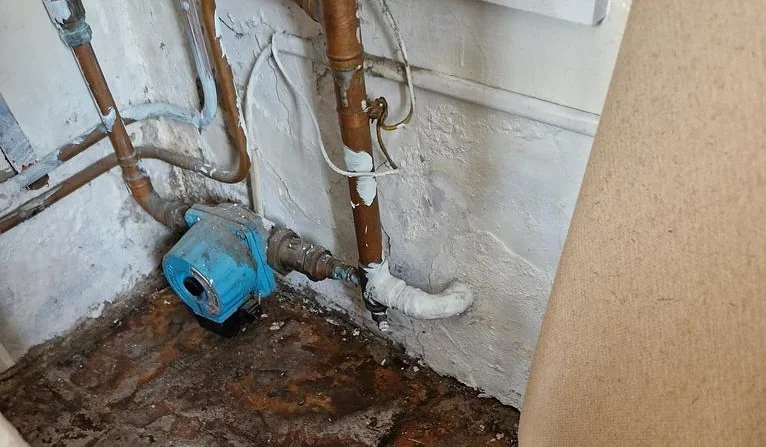
A drop in water pressure across several fittings at once points at the main water supply rather than one fixture. Low pressure has other causes, including sediment, faulty valves and ageing pipe, so look for the pattern: if the shower, taps and appliances are all weaker than normal, or the pressure changed suddenly, it is worth investigating. Our guide to why pipes leak and what to do about it covers the underlying causes.
How to Find a Hidden Water Leak in a House
Before calling anyone, three checks will tell you whether you have a leak and roughly where it is. They cost nothing and they are what a professional will ask about anyway.
The Water Meter Test
- Turn off every tap, appliance and water-using fitting in the property.
- Read the water meter and write the figure down.
- Wait an hour without using any water at all.
- Read it again. If the meter has moved, you likely have a leak somewhere.
The Stopcock Isolation Test
This tells you which side of the house the leak is on. Turn off the water at the internal stopcock, which isolates the plumbing inside the property, then repeat the meter reading. If the meter still moves with the stopcock closed, the leak is on the water supply pipe between the meter and the house. If it stops, the leak is inside.
The Toilet and Tissue Checks
Put a little food colouring in each toilet cistern and leave it half an hour without flushing. Colour appearing in the pan means water is passing continuously from cistern to bowl, which is silent and easily missed. Then run a dry tissue around visible pipe joints, isolation valves and under sinks. A slow weep leaves a mark on tissue long before it leaves a puddle.
If these checks confirm water escaping but you still cannot see where, stop looking and get it traced. Our guide to pipe leak detection methods explains how thermal imaging, acoustic testing and tracer gas locate a leak without lifting floors on a guess.
Can a Leak Happen With No Visible Signs?
Yes, and those are the expensive ones. A pipe buried in a solid floor or running inside a cavity can lose water for a long time with nothing showing at all, because the water drains into the substructure rather than surfacing. Nothing stains, nothing smells, and the only evidence is the meter.
This is why the meter test matters more than a visual inspection, and why leaving a suspected leak to see whether it gets worse is the costliest option available. Damage that develops slowly is also harder to evidence later, which matters a great deal if it becomes a claim, for the reasons set out further down this page.
How Long Can a Water Leak Go Unnoticed?
Months, routinely, and longer where the meter is never read. How long a water leak in your home stays hidden is decided not by its size but by whether anything above it is absorbent enough to show a mark. A leak under a concrete floor may never produce a stain, and the water damage is structural before it is ever visible. The same leak under floorboards with a plastered ceiling below will show within weeks.
That gap matters for insurance as well as for repair cost. Escape of water covers a sudden escape, whereas damage that has clearly developed over a long period is where insurers start asking questions. Acting on the first sign protects the claim as much as the building.
Where Hidden Leaks Usually Are
- Inside walls. Pipe runs to bathrooms and kitchens. See finding a leak in a wall.
- Under floors. Buried supply and heating pipe, often nicked at installation.
- Under sinks and basins. Traps, isolation valves and flexible tails. See leaks under a bathroom sink.
- Toilet cisterns. A continuous, silent loss that never shows as damp.
- The underground supply pipe. Between the boundary and the house, and the reason for the stopcock test.
- Heating pipework and radiator valves. Covered separately in central heating leak detection.
What to Do If You Suspect a Hidden Water Leak
- Run the water meter test, then the stopcock test, and note both results.
- Photograph every damp patch, stain and meter reading, with dates.
- Turn off the water at the stopcock if the escape is significant.
- Do not cut into walls, floors or ceilings until you know where the leak is.
- Do not clean up or replace damaged materials before they are recorded.
- Get the leak located, then repaired. Our guide to the immediate actions after finding a water leak covers the first hour.
Is a Hidden Water Leak Covered by Insurance?
Two parts of the policy usually apply and homeowners routinely claim only one. The damage to the building and contents is normally covered as escape of water. The cost of finding the leak, and of making good afterwards, is normally covered under trace and access. The failed pipe itself is generally your own repair.
Before paying for a trace, check whether the cost of locating the leak sits with your insurer, and note that you can usually choose your own detection company rather than the one the insurer nominates. Documentation is what decides the value: a Belfast escape of water claim opened at £6,000 and settled at £73,000 on the strength of the evidence gathered early.
Why Acting Quickly Protects the Claim, Not Just the Building
Most home insurance covers escape of water that is sudden and accidental. Damage that has built up slowly is commonly excluded under a gradual damage or wear and tear clause, and that is the exclusion insurers reach for most often on a hidden leak, because by definition a hidden leak has been running for a while before anyone found it. It is the single most common reason an otherwise valid escape of water claim is reduced or refused.
What usually decides the argument is not how long the water was actually escaping, which nobody can know for certain, but what you did once you had reason to suspect it. A dated meter reading, a photograph of the first stain, the date you called a plumber and the invoice that followed are what show the damage was acted on promptly. The gap between noticing and acting is the part you control, and it is the part an insurer will ask about.
This is also why it is worth reporting a suspected leak even before you have found it. If a claim has already been turned down on gradual damage grounds, that is not necessarily the end of it: see our guide to a home insurance claim being denied or disputed. In Omagh we recovered £17,000 on a water damage claim after it had been denied.
Getting a Hidden Leak Found and Claimed
PCLA does not work on no find, no fee. You get a free quote with all costs clear before any work starts, and where the leak has caused damage the detection cost is usually recoverable through the trace and access section of your claim.
Leak detection in Northern Ireland: PCLA, 028 9581 5318, or NI Leak Detection. See our leak detection service.
Leak detection in Scotland: Leak Detection Stirling covers detection across Scotland.
If you expect to claim, PCLA manages claims in Northern Ireland (028 9581 5318) and Scotland (0141 461 2406). Call before you notify your insurer, and before you accept a settlement figure.
Hidden Water Leak FAQs
How do I find a hidden water leak in a house?
Start with the water meter test. Turn off every tap and appliance, read the meter, wait an hour without using any water, and read it again. If it has moved you likely have a leak somewhere on the supply. Then isolate the internal plumbing at the stopcock and repeat, which tells you whether the leak is inside the house or on the supply pipe outside it.
What are the common signs of a hidden water leak?
An unexplained increase in your water bill, damp patches or staining on walls and ceilings, the sound of water running when everything is switched off, and a drop in water pressure. Musty smells, mould that keeps returning, and warped flooring are secondary signs that the water has been there a while.
Can a water leak happen with no visible signs?
Yes, and this is the most expensive kind. A leak on a pipe buried in a solid floor or running inside a cavity wall can lose water for months with nothing showing, because the water drains away into the substructure instead of surfacing. The meter test will usually still catch it.
How long can a water leak go unnoticed?
A slow leak behind plaster or under a floor can run for months, and sometimes longer where nobody reads the meter. The limiting factor is usually not the leak but whether anything above it is absorbent enough to show a stain. That is why the meter test matters more than a visual inspection.
How do I check if my toilet is leaking?
Put a little food colouring in the cistern and leave it half an hour without flushing. If colour appears in the pan, water is passing from the cistern into the bowl. It is one of the most common continuous losses in a house and it is silent.
Who is responsible for fixing a water leak?
Inside the property boundary the supply pipe and the internal plumbing are normally the homeowner’s responsibility. The water company is responsible for the main and usually up to the boundary. The repair being yours does not mean the damage is: escape of water and trace and access are separate parts of your home insurance.
Should I call a plumber or a leak detection company?
If you can see where the water is coming from, call a plumber. If you know water is escaping but cannot find it, the leak needs locating first, otherwise the plumber is opening floors on a guess. Locating it is the cheaper half of the job.
Is a hidden water leak covered by insurance?
The damage the water causes to the building and contents is usually covered as escape of water. The cost of finding the leak is usually covered under trace and access. The failed pipe itself is normally your own repair. You can generally choose your own leak detection company rather than the one your insurer nominates.